AI estimate as of November 8, 2025 · verify with a professional before acting
AI-Generated · Verify before acting
Everything on this page is generated by AI for informational purposes only. AI can make mistakes — the AI may misidentify items or misattribute them (artist, maker, brand, designer, origin, era). This is not an official valuation and should not be used for insurance, sale, tax, estate, legal, or lending purposes — or any decision requiring a certified appraisal. It is not an authoritative claim about any person, brand, or rights holder — do not share or rely on it as a factual statement about a third party. Always consult qualified professionals before making financial decisions.
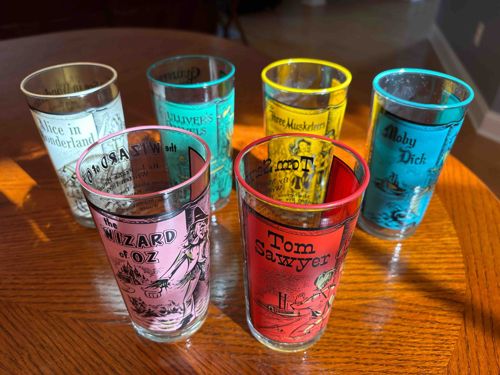
This is a set of six vintage drinking glasses, each featuring a different classic work of literature. The glasses are made of clear glass with colorful, wraparound illustrations and text. Each glass has a distinct primary background color for its illustration, including light blue for 'Alice in Wonderland,' teal for 'Gulliver's Travels,' yellow for 'The Three Musketeers,' a deeper teal/blue for 'Moby Dick,' pink for 'The Wizard of Oz,' and red for 'Tom Sawyer.' The illustrations depict scenes and characters from the respective books in a stylized, almost comic book-like or mid-century modern aesthetic, with black outline details. A metallic gold or silver band encircles the rim of each glass, showing some wear and fading consistent with age and use. The 'Alice in Wonderland' glass has a silver-tone rim and the background appears to be an aged white or light cream color, suggesting a parchment-like texture with black print of what looks like pages from the book. The 'Wizard of Oz' glass, with its prominent pink background, depicts the Wicked Witch of the West, or a similar character, and the Emerald City. The 'Tom Sawyer' glass is rendered in red and depicts Tom Sawyer on a raft. The quality of the glass appears to be standard for tumblers of their era, likely a mass-produced item. The condition suggests minor wear, particularly to the metallic rims and possibly some slight fading or scratching to the printed designs, although the colors remain vibrant overall. These glasses appear to be from the mid to late 20th century, possibly 1950s-1970s, based on the illustration style and general appearance. There are no visible chips or cracks. The set is presented on a wooden table, suggesting they are used household items.
AI Appraisal Report
I have examined the provided image of a set of six vintage classic literature drinking glasses. Based on this visual inspection, the set appears to be authentic mid-20th century (likely 1950s-1970s) promotional or decorative tumblers. The vibrant, stylized illustrations and metallic rims are consistent with design trends of that era. The general condition seems good for their age; I observe wear on the metallic rims, which is typical for frequently used vintage glassware. There are no visible chips or cracks.
From a market perspective, vintage novelty glassware like this set has a steady, though not exceptionally high, demand. Collectors are often drawn to complete sets and specific themes. The classic literature theme is appealing to a niche market of book lovers and vintage collectors. Comparable sets, often related to pop culture, advertising, or specific themes, typically sell in the range of $50-$150, depending on condition, rarity of the specific designs, and completeness of the set. The variety of titles represented here adds to its appeal. Rarity is moderate; while individual glasses might be common, a complete set in good condition is less so.
Key value factors include the completeness of the set, the distinct and attractive illustrations, and the relatively good condition for vintage items. Were there chips, cracks, or significant fading of the illustrations, the value would decrease substantially. Without in-person inspection, it is difficult to definitively assess the extent of wear on illustrations or micro-scratches on the glass, which could slightly affect value. Full authentication would ideally involve physical inspection to confirm glass quality, printing method, and detailed condition assessment, as well as checking for manufacturer marks often found on the base, which are not visible in the provided image.