AI Appraisal Estimate

AI-generated estimates · not official valuations

From the user

What was submitted

Photo and notes provided by the user — not generated by AI

Submitted item photo
Submitted photo · June 25, 2026

User's notes

No additional notes provided.

AI analysis below

AI appraisal

AI analysis & estimate

AI-Generated · Verify before acting

Everything below is generated by AI for informational purposes only. AI can make mistakes — the AI may misidentify items or misattribute them (artist, maker, brand, designer, origin, era). This is not an official valuation and should not be used for insurance, sale, tax, estate, legal, or lending purposes — or any decision requiring a certified appraisal. It is not an authoritative claim about any person, brand, or rights holder — do not share or rely on it as a factual statement about a third party. Always consult qualified professionals before making financial decisions.

Read the full disclaimer

AI Identification

·Not independently authenticated·Verify before acting

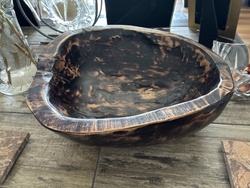
Hand-Carved Sculptural Monkey Pod Wood Bowl

Home Decor / Woodwork

AI Estimated Value

·Not an official valuation·Verify before acting

$125 - $175

As of June 25, 2026

AI Item Analysis

·AI can make mistakes·Verify before acting
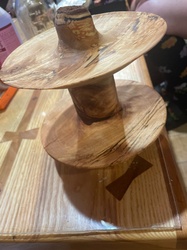
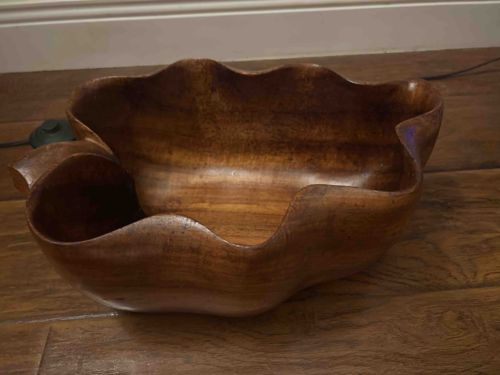
This is a large, hand-carved decorative bowl fashioned from a single piece of tropical hardwood, likely monkey pod (Samanea saman) or a similar acacia-adjacent species. The item features a distinctive sculptural form with an organic, undulating 'wavy' rim that provides significant depth and visual movement. Physically, the wood exhibits a rich, warm medium-to-dark brown color with prominent golden undertones and a visible horizontal grain pattern. The construction is solid-carved, indicative of mid-century hand-craftsmanship frequently seen in Pacific Island or Southeast Asian artisanal exports from the 1960s or 1970s. The exterior and interior surfaces are finished with a soft, semi-gloss luster that enhances the figured wood grain. In terms of condition, the piece shows evidence of age and use; there are visible surface scuffs, small nicks along the delicate rim edges, and some minor pitting or surface irregularities consistent with natural wood drying and handling over time. The craftsmanship is of high quality, evidenced by the uniform thinning of the walls and the smooth transition of the free-form curves. There are no immediately visible maker's marks in this view, which is common for such bespoke or studio-crafted wooden wares. It serves as both a functional serving piece and a mid-century modern aesthetic accent.
AI Appraisal Report

·AI can make mistakes·Verify before acting
Upon my visual examination of this large, hand-carved Samanea saman (Monkey Pod) bowl, I find it to be a quintessential example of mid-century organic modernism, likely originating from the Philippines or Hawaii between 1960 and 1975. The craftsmanship is superior to mass-produced tourist wares, evidenced by the consistent wall thickness and the sophisticated, undulating 'wavy' rim which requires significant skill to carve from a single block without fracturing the grain. The item displays a rich patina and high-character graining typical of aged tropical hardwoods. Condition-wise, the visible surface abrasions and minor nicks along the rim are consistent with age and typical of 'lived-in' mid-century decor; however, these do slightly temper the valuation compared to a mint-condition studio piece. Market demand for monkey pod wood remains steady among enthusiasts of Pacific Northwest and Polynesian Pop aesthetics. Comparable sales for similar oversized free-form bowls (14-18 inches) typically fall within the $125 to $175 range in specialty vintage markets. Limitations: This appraisal is based on photographic evidence alone. A definitive valuation would require an in-person tactile inspection to rule out structural stress fractures hidden by the finish and to confirm the absence of modern synthetic fillers. To fully authenticate the piece as a significant studio-crafted item, I would require provenance documentation or a maker’s signature, often found on the underside. Without a signature, the item is valued as a high-quality decorative 'anonymous' artisan piece rather than a collectible work by a specific known master carver.

Get your items appraised

Instant estimates of your treasures with AI-powered appraisals

Browse More Appraisals