AI estimate as of September 17, 2025 · verify with a professional before acting
AI-Generated · Verify before acting
Everything on this page is generated by AI for informational purposes only. AI can make mistakes — the AI may misidentify items or misattribute them (artist, maker, brand, designer, origin, era). This is not an official valuation and should not be used for insurance, sale, tax, estate, legal, or lending purposes — or any decision requiring a certified appraisal. It is not an authoritative claim about any person, brand, or rights holder — do not share or rely on it as a factual statement about a third party. Always consult qualified professionals before making financial decisions.
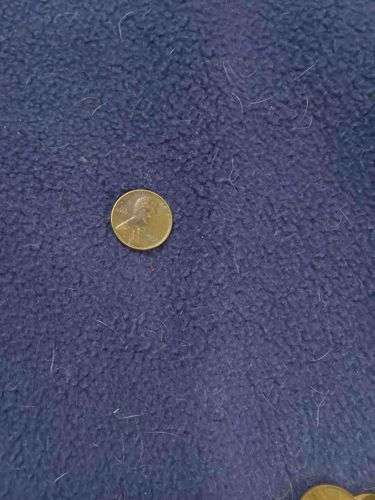
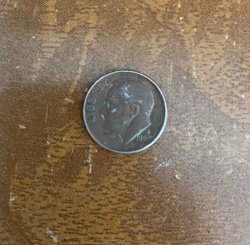
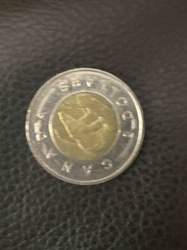
The item depicted is a single United States Lincoln Cent, commonly known as a penny, resting on a dark blue, textured fabric surface that appears to be a blanket or carpet, scattered with light-colored fibers or lint. The coin exhibits a coppery-bronze color, typical of circulating pennies. While the exact date and mint mark are not clearly discernible from the provided image due to resolution and angle, the obverse side of the coin is visible, featuring a side profile of Abraham Lincoln facing right. The details of Lincoln's bust, including his facial features and coat, show some wear but are generally recognizable. The coin appears to be in circulated condition, indicated by the subdued luster and slight softening of the design elements. There are no obvious significant scratches, dents, or major environmental damages visible from this distant perspective, though closer inspection would be required to ascertain its precise condition, grade, and any minor abrasions or spots. The overall impression is that of a standard-issue penny, likely from the latter half of the 20th century or early 21st century, given its common appearance. It is a mass-produced coin, manufactured by the United States Mint, and its value beyond its face value typically depends on its specific year, mint mark, rarity, and grade, none of which can be definitively determined from this image.
AI Appraisal Report
I have examined the provided image of a United States Lincoln Cent, commonly known as a penny. Based on this visual inspection, the coin presents as a standard, circulated bronze Lincoln Cent. The obverse, featuring the profile of Abraham Lincoln, shows noticeable wear consistent with prolonged circulation; details such as Lincoln's features and coat are softened but still discernible. The color is a typical coppery-bronze, with no apparent original luster. There are no obvious significant gouges, dents, or environmental damage visible at this resolution. I assess its condition to be 'Good' to 'Very Good' on the Sheldon scale, which for a common Lincoln Cent, places it firmly in the lower-grade circulated category.
Market conditions for common circulated Lincoln Cents are extremely low. Billions were minted, and they hold very little numismatic value above their face value. Authenticity seems straightforward; it appears to be a genuine U.S. penny, though precise date and mint mark are unreadable from the image. Demand for such a common coin is virtually non-existent among collectors, and rarity is not a factor here. Its primary value is its intrinsic face value.
Factors significantly impacting value, such as a rare date, mint mark (e.g., 1909-S VDB, 1914-D, 1931-S, 1955 Doubled Die), or uncirculated condition, cannot be determined from this image. Without a clear view of the date and mint mark, and a more detailed inspection for anomalies or die varieties, it's impossible to assign any numismatic premium. My appraisal of $0.01 reflects its face value, as there is no evidence to suggest it possesses any greater value. A physical in-person examination, including magnified viewing of both sides, proper lighting, weight, diameter measurements, and potentially spectroscopic analysis, would be necessary for full authentication and to ascertain any hidden attributes that might elevate its value beyond face value.