AI estimate as of October 26, 2025 · verify with a professional before acting
AI-Generated · Verify before acting
Everything on this page is generated by AI for informational purposes only. AI can make mistakes — the AI may misidentify items or misattribute them (artist, maker, brand, designer, origin, era). This is not an official valuation and should not be used for insurance, sale, tax, estate, legal, or lending purposes — or any decision requiring a certified appraisal. It is not an authoritative claim about any person, brand, or rights holder — do not share or rely on it as a factual statement about a third party. Always consult qualified professionals before making financial decisions.
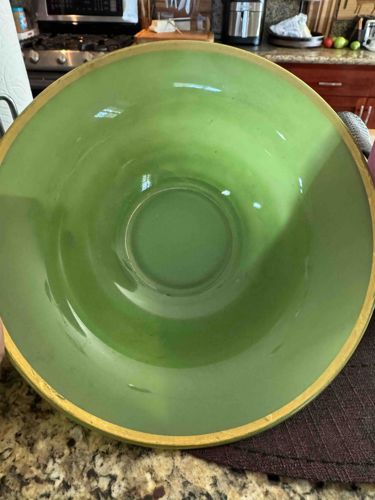
This item is a large, circular mixing bowl crafted from a translucent, apple-green colored glass. The interior of the bowl has a smooth, glossy finish, reflecting light unevenly across its surface due to subtle undulations in the glass and minor surface scratches. The color is a vibrant, somewhat muted green, consistent throughout the visible portions of the bowl. A prominent feature is the gold-colored band that encircles the rim, providing a striking contrast to the green glass. This gold band appears to be a painted or applied metallic finish, showing some signs of wear and possibly slight fading or discoloration in areas, indicating age or frequent use. The construction suggests it is a molded glass piece, characterized by its uniform thickness and the smooth curvature, which tapers down to a flattened base, forming a concentric circle at the bottom center. Visible condition issues include multiple superficial scratches on the interior surface, particularly noticeable as elongated, lighter streaks against the darker green. There are also a few small, dark specks or possibly minor inclusions within the glass, as well as a tiny chip or flea bite near the gold rim on the interior side, which is visible in one of the close-up images. The overall style suggests it could be from the mid-20th century, a period known for colored utilitarian glassware. While no specific maker's marks or signatures are visible in the provided images, the robust construction and decorative rim indicate a piece intended for both functional use and aesthetic appeal.
AI Appraisal Report
I have visually examined this green glass mixing bowl with a gold rim. Based on its appearance, it's a mid-century piece, likely from the 1940s-1960s, a period prolific for colored glass kitchenware. The vibrant apple-green color is attractive, a common shade for utilitarian glass of that era. The gold rim provides a decorative touch, though the description notes wear, which is typical for applied finishes on older, frequently used items.
Condition-wise, the visible surface scratches, dark speck inclusions, and a small chip or flea bite near the rim all detract from its value. While these are common imperfections for a vintage, used mixing bowl, they prevent it from reaching the higher end of its market. Without a maker's mark, specific attribution is difficult, which limits premium pricing. Market demand for collectible colored utilitarian glassware is steady but not fervent for unmarked pieces in this condition. Comparable green glass mixing bowls from known manufacturers like Anchor Hocking or Pyrex, in excellent condition, might fetch slightly more, but this piece, being unmarked and showing wear, falls within a more modest range. Its rarity is low; many similar bowls were produced.
Factors impacting value are primarily the condition issues and the lack of a discernible maker. A physical inspection would be crucial to confirm the extent of the chip, the texture of the glass, and to search for any faint marks that might not be visible in images. Provenance documentation, though unlikely for such an item, would be the only way to definitively authenticate specific origin or ownership history.