AI estimate as of August 11, 2025 · verify with a professional before acting
AI-Generated · Verify before acting
Everything on this page is generated by AI for informational purposes only. AI can make mistakes — the AI may misidentify items or misattribute them (artist, maker, brand, designer, origin, era). This is not an official valuation and should not be used for insurance, sale, tax, estate, legal, or lending purposes — or any decision requiring a certified appraisal. It is not an authoritative claim about any person, brand, or rights holder — do not share or rely on it as a factual statement about a third party. Always consult qualified professionals before making financial decisions.
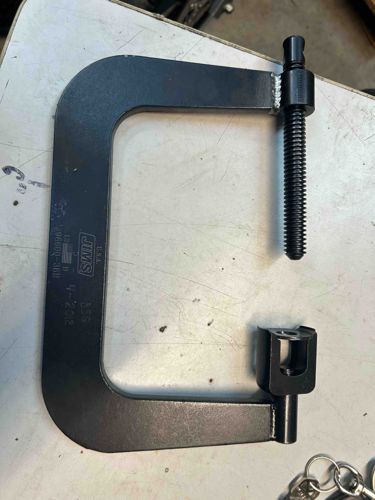
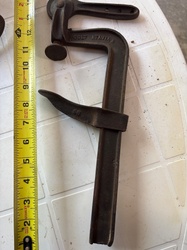
The item is a heavy-duty C-clamp, characterized by its robust, C-shaped frame. It appears to be constructed from thick, dark-colored, possibly black-oxide coated steel or cast iron, given its matte, uniform finish. The frame itself is substantial, indicating a capacity for significant clamping force. One arm of the C-frame features a finely threaded screw mechanism, which is also black, typical of tool steel. This screw has a knurled or grooved head for manual rotation or to accept a wrench. The opposing arm of the C-frame has a pivoting or swiveling foot, also black, designed to articulate and conform to the clamped surface, providing even pressure and preventing marring or slippage. The connections where the screw housing and the pivoting foot are attached to the C-frame appear to be solidly welded, suggesting high structural integrity and durability. Visible markings on the frame include text and logos, one of which clearly reads "SMI" and beneath it "USA," suggesting the manufacturer and country of origin. Other numbers visible are "4-201-1" and "SMF-0099909". The overall condition seems excellent with minimal signs of wear or rust, suggesting it is either new, recently reconditioned, or very well maintained. The finish is consistent, without significant chips or scratches, indicating quality manufacturing and a protective coating. The craftsmanship appears to be high, with clean welds and precise machining of the screw and foot components, essential for reliable and effective clamping.
AI Appraisal Report
Upon my virtual examination of this heavy-duty C-clamp, I find its condition to be excellent. The matte black finish, consistent across the robust C-frame, screw mechanism, and pivoting foot, suggests either a black-oxide coating or a high-quality paint application, which is well-preserved. There are minimal visible signs of wear, chips, or scratches, indicating careful use or a very recent reconditioning. The visible markings "SMI" and "USA," along with numbers "4-201-1" and "SMF-0099909," provide strong indicators of a specific manufacturer and country of origin. The craftsmanship, evident in the solid welds and precise machining of the screw and foot, attests to its quality and durability.
Market conditions for industrial-grade clamping tools are generally stable, with a consistent demand from professional trades, workshops, and manufacturing sectors. Comparables from reputable brands known for heavy-duty tools (e.g., Wilton, Bessey) often command premium prices due to their reliability and longevity. This "SMI USA" clamp appears to fall into this high-quality category. While not a rare antique, its robust construction and excellent condition contribute to its value. Factors significantly impacting its value include its professional-grade utility, the apparent high quality of materials and construction, and its current pristine condition.
It is crucial to note the limitations of appraising solely from images. While the visual evidence strongly suggests authenticity and high quality, I cannot definitively verify the material composition (e.g., specific steel alloy) or the precise functionality of the screw mechanism and pivoting foot without a physical examination. In-person inspection would allow me to test the screw action for smoothness, assess the integrity of the welds through tactile examination, and check for any hidden imperfections or structural fatigue. Provenance documentation, such as purchase records or manufacturing specifications, would further solidify its authenticity and provide more context regarding its history and original purpose. Scientific testing, such as material analysis, would be needed for absolute verification of its composition.