AI estimate as of October 7, 2025 · verify with a professional before acting
AI-Generated · Verify before acting
Everything on this page is generated by AI for informational purposes only. AI can make mistakes — the AI may misidentify items or misattribute them (artist, maker, brand, designer, origin, era). This is not an official valuation and should not be used for insurance, sale, tax, estate, legal, or lending purposes — or any decision requiring a certified appraisal. It is not an authoritative claim about any person, brand, or rights holder — do not share or rely on it as a factual statement about a third party. Always consult qualified professionals before making financial decisions.
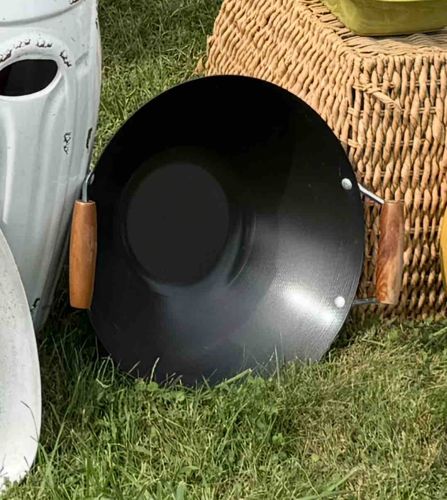
This is a round-bottomed wok, likely constructed from carbon steel due to its characteristic dark, matte black finish. The wok features two opposing wooden handles, each secured to the main body of the wok with two visible metal rivets. The handles are cylindrical and appear to be made of a light to medium-toned wood, possibly beech, stained or naturally aged to a warm brown. Their grain is visible, indicating they are solid wood and not a composite material. The wok exhibits a classic bowl-like shape, essential for traditional stir-frying and even heat distribution. The surface appears smooth, without significant pitting or rust visible in the provided image, suggesting it is either new, very well maintained, or has a protective coating. There is a slight sheen on the surface, particularly where light reflects off it, which could indicate a seasoned surface or simply light reflection on the smooth metal. There are no obvious dents, scratches, or other forms of damage visible. The attachment of the handles to the wok body appears sturdy, with the rivets evenly spaced. While no specific maker's marks or signatures are discernible from the image, the overall construction suggests a functional kitchen tool designed for Asian cuisine. Its style is timeless for a wok, making it difficult to pinpoint an exact age without further information, but it appears to be a contemporary production piece. The craftsmanship, particularly of the handle attachment, seems robust and practical.
AI Appraisal Report
Based on my visual examination of the Carbon Steel Wok with Wood Handles, I assess its condition as excellent. The dark, matte black finish characteristic of carbon steel is uniform, and there are no visible signs of rust, pitting, or significant scratches. The slight sheen suggests a well-maintained or seasoned surface, or perhaps a protective coating. The two wooden handles, likely a light-toned wood like beech, are securely attached with two rivets each, showing good craftsmanship. The classic round-bottomed shape is ideal for traditional stir-frying.
Authenticity, in terms of it being a functional carbon steel wok, is high given the visual cues. However, without maker's marks, specific brand authentication is impossible from images alone. This item appears to be a contemporary production piece, not an antique or a collector's rarity. The market for carbon steel woks is robust, driven by their durability and superior cooking properties. Comparables for new, well-made carbon steel woks with wooden handles typically range from $30 to $80, depending on brand reputation and steel gauge. This particular wok falls comfortably within the mid-range of quality seen in the current market.
Demand for such functional kitchen tools is consistently high, but rarity is low; many manufacturers produce similar items. Factors impacting its value positively are its apparent excellent condition and robust construction. Negatively impacting factors include the lack of identifiable branding or unique features that would elevate it above standard market offerings. For full authentication regarding material composition (e.g., specific steel alloy) or to verify specific wood type, in-person examination, material testing, or provenance documentation (receipts, manufacturer details) would be essential. Without these, my appraisal is based solely on visual attributes and general market knowledge for similar items.