These notes were written by the person who submitted this item. Appraiser.AI has not verified them, and the AI's identification and estimate may rely on them.
AI Estimated Value
Not an official valuation
$1,800 - $3,000
AI estimate as of July 12, 2025 · verify with a professional before acting
AI-Generated · Verify before acting
Everything on this page is generated by AI for informational purposes only. AI can make mistakes — the AI may misidentify items or misattribute them (artist, maker, brand, designer, origin, era). This is not an official valuation and should not be used for insurance, sale, tax, estate, legal, or lending purposes — or any decision requiring a certified appraisal. It is not an authoritative claim about any person, brand, or rights holder — do not share or rely on it as a factual statement about a third party. Always consult qualified professionals before making financial decisions.
This analysis also relies on unverified notes provided by the user, which may be incomplete or inaccurate and could affect the result.
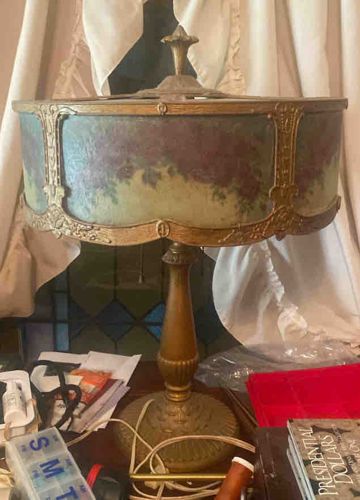
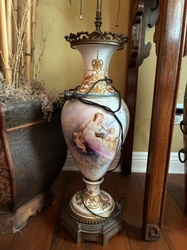
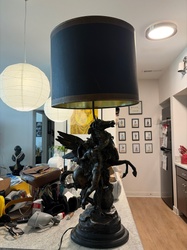
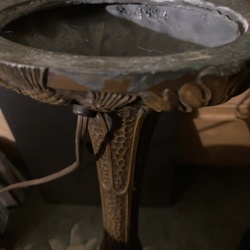
This is an antique or vintage table lamp featuring a reverse-painted glass shade. The shade is approximately cylindrical with slightly flared sides, and it exhibits a warm, organic color palette dominated by shades of green transitioning into muted burgundy or plum tones, typical of nature-inspired landscapes often found in Arts and Crafts or Art Nouveau period lamps. The painted design appears abstract or atmospheric, possibly depicting foliage or a hazy landscape, visible through the interior of the glass. The exterior of the shade is framed by ornate, possibly cast metal (bronze or brass-toned), decorative elements. These elements include a fluted or reeded band along the top rim, and more elaborate, curvilinear, and possibly botanical-inspired castings that secure the glass panels and form the lower edge of the shade, extending downwards in scroll-like motifs. There is a prominent finial at the top of the lamp's structure, likely securing the shade. The lamp base appears to be constructed of a similar bronze or brass-toned metal, featuring a turned, baluster-shaped standard leading down to a circular, ornate base. The base itself seems to have embossed or molded patterns, possibly floral, geometric, or stylized, adding to its decorative appeal. The overall condition shows signs of age, including potential patina on the metal elements consistent with oxidation over time, and some possible wear on the painted shade, though its specific condition is hard to ascertain fully from the image. The style points towards an early 20th-century aesthetic, possibly between 1900 and 1930, indicative of the Arts and Crafts or Art Nouveau movements, which favored natural forms and handcrafted appearances. The craftsmanship appears to be of good quality, with attention to decorative detail in both the metalwork and the hand-painted glass.
AI Appraisal Report
Upon examining the provided image of this reverse-painted glass table lamp, my initial assessment supports its attribution to the early 20th century, likely between 1900 and 1930, aligning with the Arts and Crafts or Art Nouveau aesthetics. While I cannot definitively authenticate the piece without a physical inspection, the design elements—specifically the naturalistic, muted color palette of the reverse-painted shade and the ornate, curvilinear metalwork—are highly consistent with lamps of that period.
From the image alone, the condition appears good for its age, exhibiting a desirable patina on the metal, which indicates authenticity rather than significant damage. The reverse painting on the glass, while showing the expected atmospheric quality, does not present obvious signs of flaking or significant wear. The intricate metal fittings, including the finial, reeded band, and decorative base, suggest quality craftsmanship, likely bronze or brass-toned.
In terms of market conditions, reverse-painted lamps from the early 20th century, especially those with original shades and detailed metalwork, consistently command strong interest among collectors of antique lighting, Arts and Crafts, and Art Nouveau furniture. The demand for well-preserved examples remains steady, driven by their decorative appeal and historical significance. Comparable sales often include lamps from makers such as Handel, Pairpoint, or Duffner & Kimberly, though without maker's marks or provenance, attributing it to a specific manufacturer is impossible. The rarity of such pieces depends heavily on the specific design, maker, and condition; this piece, with its appealing design, contributes positively to its market value.
Factors significantly impacting its value include the originality of all components, the integrity of the reverse painting, and the absence of repairs or major damage to the metalwork. Evidence of original wiring, while potentially a safety concern, can also indicate authenticity, though most collectors prefer updated wiring for practical use.
My primary limitation in this appraisal is the lack of physical examination. A hands-on inspection would allow me to verify the material composition of the metal, check for artist or manufacturer's signatures/marks on the shade or base, assess the precise condition of the paint (e.g., craquelure, flaking), confirm whether the glass is original to the base, and inspect internal components for repairs or alterations. Provenance documentation (e.g., original sales receipts, historical ownership records) would further solidify authenticity and potentially increase value considerably. Scientific testing (e.g., metallurgical analysis) would be necessary for definitive material identification if there were any doubts.