AI estimate as of June 14, 2025 · verify with a professional before acting
AI-Generated · Verify before acting
Everything on this page is generated by AI for informational purposes only. AI can make mistakes — the AI may misidentify items or misattribute them (artist, maker, brand, designer, origin, era). This is not an official valuation and should not be used for insurance, sale, tax, estate, legal, or lending purposes — or any decision requiring a certified appraisal. It is not an authoritative claim about any person, brand, or rights holder — do not share or rely on it as a factual statement about a third party. Always consult qualified professionals before making financial decisions.
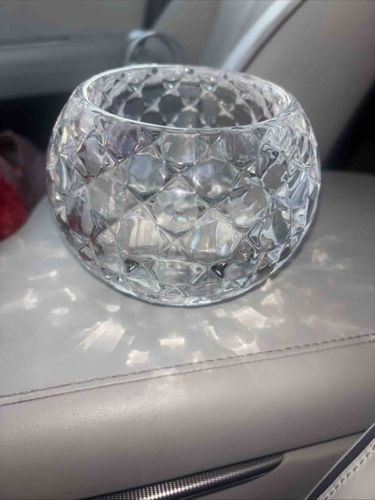
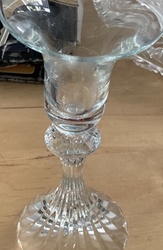
The item is a small, spherical clear glass vessel, likely intended as a votive candle holder or a small vase. It has a wide opening at the top with a slightly flattened rim. The exterior surface is completely covered in a raised diamond pattern, creating a faceted effect that catches and reflects light. The pattern appears to be uniform across the entire body of the vessel. The interior is smooth. The base is rounded, allowing the holder to sit stably but potentially concentrating weight on the perimeter of the base. The glass is clear and appears to be free of cracks or chips based on the visible areas. No manufacturer's marks, signatures, or stamps are discernible in the image. The clarity of the glass and the regularity of the faceting suggest a manufactured item, possibly from the late 20th or early 21st century. The condition appears to be very good with no noticeable wear or damage. The light reflecting off the facets is visible on the surface it is resting on, indicating the light- refracting properties of the material and design. The overall craftsmanship appears decent for a mass-produced item, with the pattern consistently applied.
AI Appraisal Report
I have examined the provided image of a small, spherical, clear glass votive candle holder with a raised diamond faceted pattern. Based on the visual information, the condition appears to be very good, with no apparent chips, cracks, or significant wear. The glass is clear, and the faceting is consistently applied, suggesting it is a mass-produced item, likely manufactured in the late 20th or early 21st century. The lack of any discernible maker's marks, signatures, or stamps prevents identification of a specific manufacturer or period without further information or physical examination.
In terms of market conditions, similar contemporary faceted glass votives or small vases are commonly available in home decor stores and online marketplaces. These items are typically mass-produced and sold at accessible price points. Comparables for generic, contemporary faceted glass votive holders manufactured without specific brand identification or notable artistic merit fall within the lower end of the glassware market.
Demand for such common home decor items is generally stable but not driven by rarity or collectible interest. The item's value is primarily based on its utility and decorative appeal rather than intrinsic collectible worth.
Factors significantly impacting value would include confirming it was produced by a known or collectible glass manufacturer (e.g., Baccarat, Waterford, although the style isn't typical) or if it possessed unique historical or artistic significance, none of which is evident from the image. Without manufacturer identification, it is considered generic.
It is crucial to note the limitations of this appraisal based solely on the image. Authenticity, specifically confirming the manufacturer and period, cannot be definitively determined without a physical in-person examination, which would allow for inspection of the base for faint marks, assessment of the glass quality and manufacturing technique in detail, and comparison with known examples. Provenance documentation could also provide valuable context regarding its origin and history. Scientific testing is not typically required for an item of this nature unless there were suspicions of it being vintage fine art glass, which this appears not to be.