AI estimate as of August 25, 2025 · verify with a professional before acting
AI-Generated · Verify before acting
Everything on this page is generated by AI for informational purposes only. AI can make mistakes — the AI may misidentify items or misattribute them (artist, maker, brand, designer, origin, era). This is not an official valuation and should not be used for insurance, sale, tax, estate, legal, or lending purposes — or any decision requiring a certified appraisal. It is not an authoritative claim about any person, brand, or rights holder — do not share or rely on it as a factual statement about a third party. Always consult qualified professionals before making financial decisions.
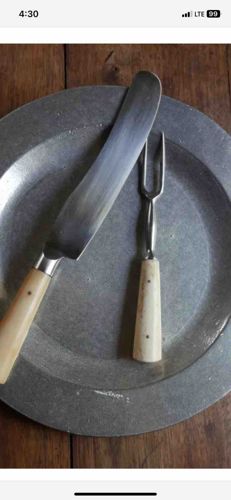
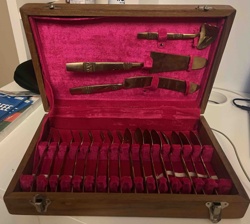
This item is a two-piece carving set, consisting of a carving knife and a carving fork, displayed on what appears to be a pewter or tin plate. Both utensils feature an antique aesthetic, suggesting an older age. The knife has a long, relatively wide blade that appears to be made of polished steel or a similar metal, exhibiting some visible scratches and minor discoloration consistent with age and use. The handle of the knife is off-white or ivory-colored, likely made from bone, ivory, or a synthetic imitation designed to mimic these natural materials. It is secured to the tang of the blade with at least two small, dark metal pins, one of which is clearly visible. A silver-colored ferrule separates the blade from the handle, adding a decorative and structural element. The carving fork is two-pronged, made of the same or similar metal as the knife blade, and also shows signs of use. Its handle matches that of the knife, being off-white and secured with visible dark pins. The overall condition suggests a functional set that has been used over many years, acquiring a natural patina and characteristic wear. There are no immediately discernible maker's marks or elaborate carvings, but the simple, robust construction indicates utilitarian quality. The style harks back to 19th or early 20th century kitchenware, prior to the widespread use of plastic handles. The quality of craftsmanship appears to be sturdy and practical, rather than highly ornate.
AI Appraisal Report
Upon visual examination of the provided image, this two-piece carving knife and fork set presents as an authentic antique, likely dating from the late 19th to early 20th century. The robust construction, materials (polished steel blade, two-pronged fork, and off-white/ivory-colored handles secured with pins), and wear patterns are consistent with period utilitarian kitchenware. The visible scratches, minor discoloration on the blade, and natural patina on the handles suggest genuine age and extensive use, not artificial aging. The ferrule adds to its period authenticity.
From a market perspective, antique carving sets like this have a steady, albeit niche, demand among collectors of antique kitchenalia and those seeking functional vintage items for use or display. While not exceedingly rare, sets in good, usable condition retain value. Factors impacting value positively include the complete two-piece nature and the apparent structural integrity. Value is limited by the lack of discernible maker's marks, which would significantly increase desirability and price for brand-specific collectors. The material of the handles—whether natural ivory, bone, or a historically appropriate synthetic imitation—is a key determinant. Genuine ivory, while adding historical accuracy, also involves ethical and legal considerations for sale.
Based on visual assessment alone, I cannot definitively confirm the handle material (ivory vs. bone vs. early synthetic) or the precise metal composition. In-person examination would allow for tactile assessment of the handle material, closer inspection for miniature maker's marks or hallmarks, and a more thorough evaluation of blade sharpness and structural integrity. Provenance documentation (e.g., family history or previous ownership records) would further authenticate its history and potentially enhance its value. Scientific testing could conclusively identify handle material if needed for legal compliance or definitive appraisal. Without these, the appraisal remains an informed estimate.
Considering its good antique condition for functional use, and in the absence of high-end materials or prominent maker's marks, it represents a solid example of its type.