AI estimate as of October 12, 2025 · verify with a professional before acting
AI-Generated · Verify before acting
Everything on this page is generated by AI for informational purposes only. AI can make mistakes — the AI may misidentify items or misattribute them (artist, maker, brand, designer, origin, era). This is not an official valuation and should not be used for insurance, sale, tax, estate, legal, or lending purposes — or any decision requiring a certified appraisal. It is not an authoritative claim about any person, brand, or rights holder — do not share or rely on it as a factual statement about a third party. Always consult qualified professionals before making financial decisions.
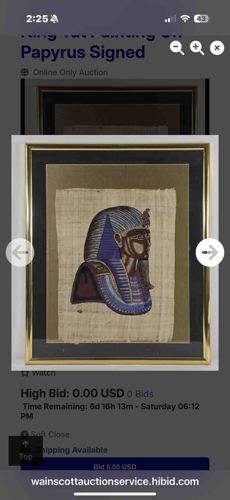
This item is a framed piece of papyrus artwork featuring a head-and-shoulders depiction of King Tutankhamun, recognizable by his distinctive nemes headdress with the cobra and vulture emblems. The artwork is presented in a rectangular frame with a gold-toned finish, suggesting either polished metal or a painted wood/resin material. Inside the frame, a black mat board surrounds the papyrus, which is further set against a light brown or tan backing. The papyrus itself, characterized by its fibrous and slightly textured surface, bears the hand-painted image of the pharaoh. His regalia is depicted in vibrant blues, golds, and reddish-browns, showcasing the traditional colors associated with ancient Egyptian art. The blues are particularly prominent in the stripes of the nemes and the ceremonial collar, while gold accents highlight features like the pharaoh's crown cobra, beard, and details on the collar. The pharaoh's skin tone appears a rich reddish-brown. The visible texture of the papyrus indicates its authentic material, and subtle variations in color and faint lines suggest its age or natural characteristics. There are no obvious signs of significant damage such as tears or large stains visible through the frame, though the papyrus as a natural material inherently displays minor irregularities. The overall presentation, with the matting and framing, enhances its display quality, suggesting it was intended as decorative art. The 'Signed' in the online listing title implies the artwork may bear an artist's signature, though it is not discernible in the provided image. This piece is likely a modern reproduction or artistic interpretation of ancient Egyptian themes, created as decorative art rather than an authentic ancient artifact. The style is illustrative, aiming to capture the iconic imagery of ancient Egypt.
AI Appraisal Report
Based on my visual examination of the provided image, this framed papyrus art depicting King Tutankhamun appears to be in very good condition. The papyrus itself, with its characteristic fibrous texture, shows no obvious signs of significant tearing, major staining, or degradation visible through the frame. The colors of the pharaoh's regalia—vibrant blues, golds, and reddish-browns—appear well-preserved and unfaded. The matting and gold-toned frame also seem intact and in good decorative order.
Regarding authenticity, it is critical to state that this piece is undoubtedly a modern decorative item, an artistic interpretation or reproduction of ancient Egyptian themes, rather than an authentic ancient artifact. The style, presentation, and common availability of such pieces indicate this. The visible 'papyrus' material likely is genuine papyrus, but the artwork upon it is contemporary.
Market conditions for such decorative papyrus art are generally moderate. These items are widely available in gift shops, online marketplaces, and at tourist destinations in Egypt. Comparable items typically sell in the $30-$150 range, depending on size, quality of framing, and perceived artistry. Demand for such pieces is steady among those looking for Egyptian-themed decorative art, but they are not considered rare.
A key factor impacting value is that it is a decorative reproduction. Higher value would only be attained if it were an authentic ancient artifact (which it is not) or a piece by a recognized contemporary artist known for this style (which is unlikely for a piece like this). The implied 'Signed' status in the listing could add a small premium if the artist were known, but without a visible signature or artist's reputation, it adds no discernible value.
Limitations: Without physical inspection, I cannot confirm the absolute integrity of the papyrus under the matting or definitively rule out minor imperfections not visible in the image. More importantly, while I can confidently assert it is not an ancient artifact from the image, an in-person examination would be needed to verify the type and quality of the papyrus and the paint medium. Provenance documentation or scientific testing (e.g., carbon dating for the papyrus, pigment analysis) would be required to authenticate it as a genuine ancient piece, which, again, is highly improbable given its nature.