AI estimate as of August 9, 2025 · verify with a professional before acting
AI-Generated · Verify before acting
Everything on this page is generated by AI for informational purposes only. AI can make mistakes — the AI may misidentify items or misattribute them (artist, maker, brand, designer, origin, era). This is not an official valuation and should not be used for insurance, sale, tax, estate, legal, or lending purposes — or any decision requiring a certified appraisal. It is not an authoritative claim about any person, brand, or rights holder — do not share or rely on it as a factual statement about a third party. Always consult qualified professionals before making financial decisions.
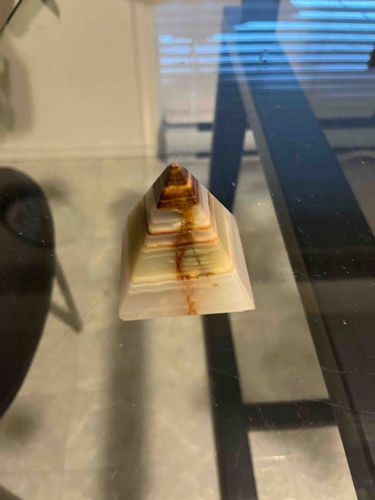
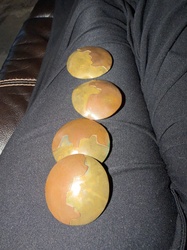
The item is a small, polished pyramid-shaped decorative object, likely intended for display or as a paperweight. It is crafted from a type of banded stone, most likely Onyx or a similar variegated marble, exhibiting distinct layers of color. The primary colors visible are shades of cream, light green, and white, interspersed with prominent veins and streaks of earthy brown, russet, and darker amber tones. These darker inclusions appear to run vertically from the base towards the apex, creating a natural focal point. The surface of the pyramid appears to be smooth and highly polished, reflecting ambient light, which suggests good craftsmanship in its finishing. The form is a classic four-sided pyramid with a square base, tapering symmetrically to a sharp point at the top. The edges appear crisp and well-defined, indicating precision in cutting and shaping. There are no readily visible chips, cracks, or significant abrasions on the polished surfaces, suggesting the item is in good to excellent condition. The natural banding and coloration of the stone are its most distinguishing features, making each piece unique. Given the material and common decorative trends, this item likely dates from the late 20th or early 21st century. No manufacturing marks or signatures are discernible from the provided images. Its relatively small size, judging by its appearance on a table surface, positions it as a desk accessory or shelf adornment.
AI Appraisal Report
Based on my visual examination of the provided image, this Banded Onyx or Marble Pyramid is in excellent condition. The highly polished surface shows no visible chips, cracks, or significant abrasions, which speaks to good preservation and quality craftsmanship. The natural banding of cream, light green, white, and earthy brown tones is striking and well-defined, indicating a genuine stone. Authenticity, based solely on visual inspection, appears sound for a natural stone decorative object; however, a physical examination would confirm the stone type definitively (Onyx vs. Marble) and rule out any synthetic materials or significant repairs not visible in the image. From a market perspective, decorative stone pyramids of this size and material are generally not rare. They fall into the category of mid-range desk accessories or decorative accents. Comparables in the market, including online retailers and natural stone shops, typically range from modest prices for smaller, common examples to higher prices for larger, more intricately veined, or rare stone types. Demand is steady for such items, driven by interior design trends and a general appreciation for natural materials. Factors impacting value include the aesthetic appeal of the banding, the precision of the cut and polish, and the overall condition. The unique banding on this particular piece adds to its individual appeal. Limitations in authenticity verification from an image alone are significant for precise stone identification. A physical in-person examination would allow for tactile assessment, microscopic inspection of the stone's crystalline structure, and density testing to confirm the exact mineral composition. Provenance documentation, though unlikely for an item of this nature, would establish its history. Scientific testing, such as Raman spectroscopy, would definitively identify the stone if precise identification were critical.