AI estimate as of November 13, 2025 · verify with a professional before acting
AI-Generated · Verify before acting
Everything on this page is generated by AI for informational purposes only. AI can make mistakes — the AI may misidentify items or misattribute them (artist, maker, brand, designer, origin, era). This is not an official valuation and should not be used for insurance, sale, tax, estate, legal, or lending purposes — or any decision requiring a certified appraisal. It is not an authoritative claim about any person, brand, or rights holder — do not share or rely on it as a factual statement about a third party. Always consult qualified professionals before making financial decisions.
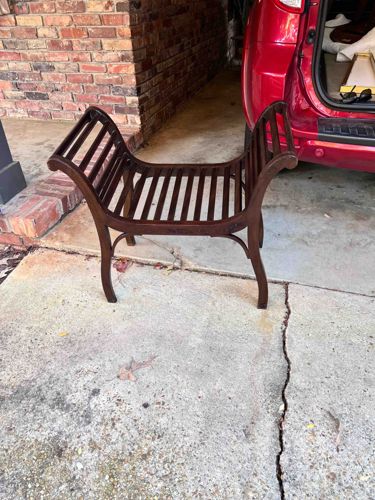
This is a vintage garden bench, seemingly constructed from cast iron or a similar heavy metal, with a dark, possibly weathered brown or bronze-colored finish that exhibits some oxidation and patina consistent with outdoor use. The bench features a distinctive curved, U-shaped design, serving as both the seat and the backrest, composed of numerous horizontal slats. These slats are evenly spaced and appear to be securely fastened to the curved side rails. The side rails themselves curve elegantly upward at each end, forming rudimentary armrests and a supportive structure for the back and legs. The legs are slender, curved members that extend downwards, providing stability. The overall aesthetic suggests a classic or traditional garden furniture style, possibly dating from the mid-20th century or earlier, given the visible wear and construction. There are no obvious manufacturing marks or elaborate decorative elements visible in the provided images, indicating a focus on functionality and simple form. The condition appears fair, with visible signs of age and outdoor exposure, including dirt and some surface wear, but no apparent structural damage such as cracks or breaks in the metalwork. The craftsmanship appears sturdy and functional, designed for durability in an outdoor setting.
AI Appraisal Report
I have examined the Vintage Slat-Back Garden Bench based on the provided image. The bench appears to be constructed from cast iron or a similar heavy metal, displaying a weathered dark finish, consistent with outdoor use and age. The design is a classic curved slat-back style, offering both a seat and backrest. The visible wear, oxidation, and patina support its vintage claim, suggesting a mid-20th century or earlier origin. I assess its condition as fair; while there are clear signs of age and outdoor exposure including dirt and surface wear, no structural damage, cracks, or breaks are apparent, indicating a robust and functional piece.
From a market perspective, vintage garden furniture of this style generally sees steady demand, especially for well-preserved or easily restorable pieces. Comparables for unrestored, functional cast iron garden benches typically fall within the $300-$600 range, depending heavily on provenance, designer attribution, and overall condition. This bench's lack of obvious manufacturing marks or elaborate decorative elements points to a focus on utility rather than high-end design, which tempers its upper market potential.
The rarity is moderate; while not unique, this style is less common than mass-produced contemporary pieces, contributing modestly to its value. Factors impacting value include its sturdy construction and classic aesthetic. However, the visible signs of wear and surface dirt suggest a need for cleaning and potentially a new finish to maximize its appeal to a broader market.
It is crucial to note that my assessment of authenticity and material is limited by visual examination of an image. A definitive determination of the metal composition (e.g., cast iron vs. other alloys), precise age, and full structural integrity would require an in-person examination. Physical inspection would allow me to test for metal type, identify any obscured maker's marks, thoroughly assess for hairline cracks or repairs, and confirm stability. Provenance documentation, such as original purchase receipts or family history, would also significantly enhance authenticity verification, which is impossible from an image alone.