AI estimate as of July 14, 2025 · verify with a professional before acting
AI-Generated · Verify before acting
Everything on this page is generated by AI for informational purposes only. AI can make mistakes — the AI may misidentify items or misattribute them (artist, maker, brand, designer, origin, era). This is not an official valuation and should not be used for insurance, sale, tax, estate, legal, or lending purposes — or any decision requiring a certified appraisal. It is not an authoritative claim about any person, brand, or rights holder — do not share or rely on it as a factual statement about a third party. Always consult qualified professionals before making financial decisions.
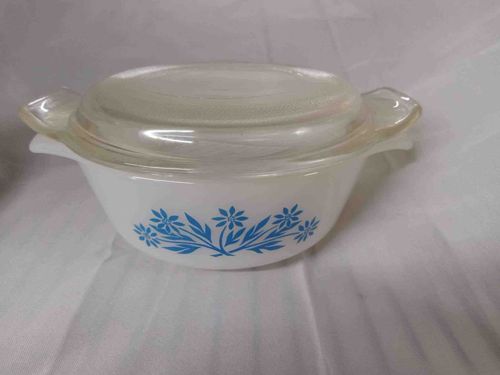
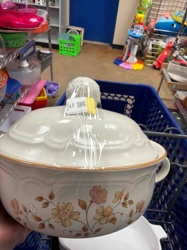
This item is a vintage Pyrex Casserole Dish, specifically the 473-B 1-quart size from the 'Butterprint' pattern, often referred to as 'Amish' or 'Farmhouse' by collectors, though the flowers depicted are clearly non-Amish. It consists of two main components: a white opal glass casserole dish and a clear glass lid. The dish is oval-shaped with flared handles on each end, allowing for easy lifting. Its primary color is opaque white, which serves as a background for the distinctive blue floral pattern that wraps around two sides of the dish. The pattern features stylized blue flowers and leaves, characteristic of mid-century aesthetics. The clear glass lid has a slight dome shape and a subtle rim that fits snugly into the casserole dish's opening, complete with small, integrated handles that align with the dish's body handles. The glass components appear to be in good overall condition for their age, exhibiting typical signs of use but no obvious chips, cracks, or significant damage to either the dish or the lid. The patterned enamel on the white base appears to be largely intact with good color saturation, showing minimal fading or scratching that would indicate heavy wear. Pyrex items from this era are known for their durability and heat resistance, making them functional as well as collectible. The craftsmanship is typical of mass-produced borosilicate glass, with smooth finishes and precise molding. The overall aesthetic points to a manufacturing period likely in the late 1950s to early 1960s, a popular era for decorated opal glass kitchenware.
AI Appraisal Report
Based on my visual examination of the Pyrex 473-B 'Butterprint' blue floral casserole dish with its clear lid, the item appears to be in good vintage condition. The iconic blue floral pattern, characteristic of the late 1950s to early 1960s, exhibits good color saturation and minimal signs of wear, such as fading or scratching, which is excellent for its age and suggests it was well-cared for. Both the white opal glass dish and the clear glass lid show no obvious chips, cracks, or significant damage, which are critical factors for Pyrex collectibles. The flared handles and overall molding appear consistent with authentic Pyrex manufacturing from that era.
Market conditions for vintage Pyrex, especially popular patterns like 'Butterprint,' remain relatively strong. However, numerous pieces of this specific pattern and size were produced, making it not inherently rare. Demand is consistent among collectors and enthusiasts of mid-century kitchenware. The 1-quart 473-B size is common within the Butterprint line, and while desirable, it doesn't command the premium of less common sizes or complete sets. Factors positively impacting value include the intact pattern, lack of significant damage, and the presence of the original lid.
Limitations to authenticity verification based on images alone include the inability to detect hairline cracks, fleabites, or internal stress fractures. I cannot physically assess surface texture, weight, or the exact feel of any minor abrasions that would be noticeable upon tactile inspection. Furthermore, without provenance documentation, the item's history of ownership and usage cannot be fully verified. Scientific testing, such as elemental analysis of the glass, would be required for absolute certainty regarding material composition and manufacturing period, though the visual cues are highly indicative of authentic vintage Pyrex. Minor internal scratching from use is possible but not discernible from the provided image.