These notes were written by the person who submitted this item. Appraiser.AI has not verified them, and the AI's identification and estimate may rely on them.
AI Estimated Value
Not an official valuation
$95-145
AI estimate as of August 28, 2025 · verify with a professional before acting
AI-Generated · Verify before acting
Everything on this page is generated by AI for informational purposes only. AI can make mistakes — the AI may misidentify items or misattribute them (artist, maker, brand, designer, origin, era). This is not an official valuation and should not be used for insurance, sale, tax, estate, legal, or lending purposes — or any decision requiring a certified appraisal. It is not an authoritative claim about any person, brand, or rights holder — do not share or rely on it as a factual statement about a third party. Always consult qualified professionals before making financial decisions.
This analysis also relies on unverified notes provided by the user, which may be incomplete or inaccurate and could affect the result.
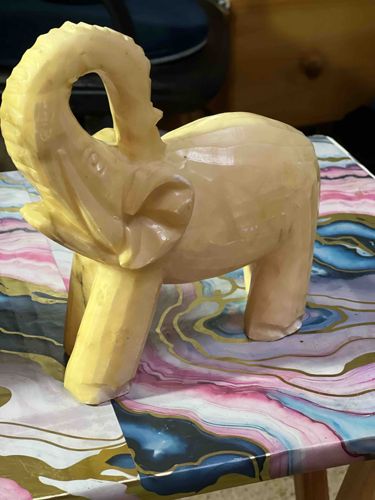
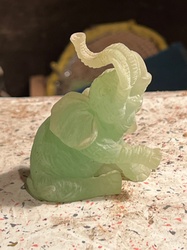
This is a carved elephant figurine crafted from what appears to be a light-colored onyx, consistent with the provided information. The overall dimensions are approximately 7.5 inches in height and 7 inches in length, and it weighs close to 4 pounds, suggesting a solid construction. The material exhibits a pale, creamy yellow to light tan hue with natural veining and variations in translucency characteristic of onyx, indicating its authenticity as a stone carving. The elephant is depicted standing on all four legs, with its trunk raised high and curled, a posture often associated with good luck or greeting. The carving exhibits a somewhat stylized, rather than hyper-realistic, form, with broad, rounded body planes and simplified, block-like legs. There are visible tool marks or facets on the surface, particularly noticeable on the trunk, ears, and legs, suggesting a hand-carved origin. The ears are large and fan-shaped, curving back towards the body. The eyes are not explicitly delineated, contributing to the stylized aesthetic. The overall finish appears polished, giving the surface a soft sheen, though some areas may show minor surface irregularities typical of natural stone and hand craftsmanship. No obvious cracks, chips, or significant damage are visible, though closer inspection might reveal subtle wear consistent with age or handling. There are no discernible maker's marks, signatures, or stamps evident from the provided images. Given its material and general aesthetic, it likely dates from the mid to late 20th century, representing a common style for decorative stone carvings of that period. The craftsmanship is solid, with a focus on form and material rather than intricate detailing, making it a robust and aesthetically pleasing decorative piece.
AI Appraisal Report
Upon examining the provided image and information for this carved onyx elephant figurine, I assess its condition as very good. There are no apparent chips, cracks, or significant damage visible, and the polished finish appears well-maintained. The material, a light-colored onyx with characteristic veining and translucency, strongly supports its authenticity as a natural stone carving. The dimensions (7.5” H x 7” L) and weight (nearly 4 lbs) indicate a substantial and solid piece.
This piece aligns with decorative stone carvings from the mid to late 20th century. Its stylized form and solid craftsmanship are typical of the period. While decorative elephant figurines in various materials are common, large, well-executed onyx examples like this hold modest collector interest. Comparable sales for similar-sized vintage decorative onyx animals on the secondary market typically range from $75 to $150, depending on detail, material quality, and condition.
Factors impacting its value include its good condition, the solid nature of the onyx, and the symbolic 'good luck' posture of the raised trunk. However, the lack of intricate detailing, artist signature, or unique historical significance limits its upper market potential. Demand is steady for appealing decorative stone items, though not indicative of high rarity.
A limitation of this assessment is purely visual verification. While the material appears to be authentic onyx, an in-person examination would allow for tactile inspection of the surface, verification of the stone's hardness and exact density, and a more thorough search for any subtle marks or repairs. Provenance documentation could potentially enhance value, though it is unlikely for this type of decorative item. Scientific testing would be necessary for definitive material verification beyond doubt, but based on visual evidence, it is consistent with onyx.