AI estimate as of October 8, 2025 · verify with a professional before acting
AI-Generated · Verify before acting
Everything on this page is generated by AI for informational purposes only. AI can make mistakes — the AI may misidentify items or misattribute them (artist, maker, brand, designer, origin, era). This is not an official valuation and should not be used for insurance, sale, tax, estate, legal, or lending purposes — or any decision requiring a certified appraisal. It is not an authoritative claim about any person, brand, or rights holder — do not share or rely on it as a factual statement about a third party. Always consult qualified professionals before making financial decisions.
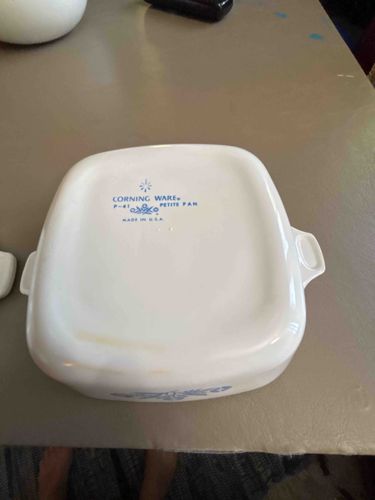
This item is a vintage Corning Ware 'Petite Pan,' specifically model P-41, identified by the blue text marking on its underside. It is constructed from a white, opaque ceramic-glass material, characteristic of Corning Ware's heat-resistant pyroceram. The pan has a square shape with gently rounded corners and features small, integrated handles on two opposing sides, suggesting it's designed for individual servings or small baked goods. The design on the side of the pan appears to be the 'Cornflower' pattern, a classic blue floral motif that is iconic to the early Corning Ware collections. The base of the pan clearly displays the 'CORNING WARE' logo, 'P-41', 'PETITE PAN', and 'MADE IN U.S.A.' in a signature blue font. This manufacturing information indicates its origin and model number. In terms of condition, there is a noticeable yellow-brown discoloration or stain on one side of the white exterior, consistent with food residue or prolonged use, which is a common form of wear for cookware of this age. The overall glaze appears intact, but the discoloration suggests that it has been used. The item likely dates from the mid-20th century, given the typical production period for Cornflower patterned Corning Ware. It represents a durable and functional piece of kitchenware known for its versatility from freezer to oven to table.
AI Appraisal Report
Upon examining the provided image of the Corning Ware P-41 Petite Pan, I can confirm its authenticity based on the clear 'CORNING WARE' logo, 'P-41', 'PETITE PAN', 'MADE IN U.S.A.' markings, and the distinctive 'Cornflower' pattern. These elements are consistent with genuine vintage Corning Ware from the mid-20th century. The piece is made of the characteristic white, opaque ceramic-glass (pyroceram).
Regarding condition, I observe a noticeable yellow-brown discoloration or stain on one side of the exterior. While the overall glaze appears intact, this discoloration suggests significant use and is common wear for vintage cookware. This cosmetic flaw slightly reduces its collectible value, as collectors generally prefer pristine examples.
In terms of market conditions, vintage Corning Ware, particularly the 'Cornflower' pattern, is widely available. While beloved for its nostalgic appeal and durability, it is not rare, with millions of pieces produced. Smaller items like the P-41 Petite Pan are generally less sought after than larger casseroles or complete sets. Demand for individual petite pans is modest, primarily from collectors completing sets or individuals seeking functional vintage kitchenware. Comparables for 'Cornflower' P-41 petite pans in good, but not perfect, condition typically sell in the range of $10-$20 on online marketplaces.
Factors significantly impacting value here are primarily the condition (the discoloration being a negative) and its commonality. While authentic, its widespread availability and the specific wear noted limit its premium potential.
It is important to note that my assessment of authenticity and condition is based solely on the provided image. A full, in-person examination would allow for tactile inspection of the surface for chips, cracks, or fading not visible in photographs, and to confirm the exact nature and permanence of the discoloration. Provenance, such as original packaging or purchase receipts, would further strengthen authentication, though it is rarely available for common cookware.