AI estimate as of July 17, 2025 · verify with a professional before acting
AI-Generated · Verify before acting
Everything on this page is generated by AI for informational purposes only. AI can make mistakes — the AI may misidentify items or misattribute them (artist, maker, brand, designer, origin, era). This is not an official valuation and should not be used for insurance, sale, tax, estate, legal, or lending purposes — or any decision requiring a certified appraisal. It is not an authoritative claim about any person, brand, or rights holder — do not share or rely on it as a factual statement about a third party. Always consult qualified professionals before making financial decisions.
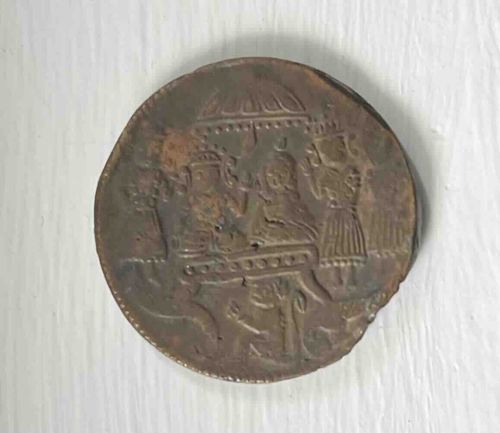
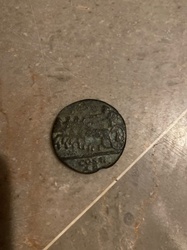
This item is a circular, flat, metallic object, likely a coin or a medallion, exhibiting significant age and wear. Its color is a dark, mottled brown with hints of green and reddish-brown patination, indicative of copper or bronze composition and prolonged exposure to elements. The edges are irregular, suggesting a hand-struck or crudely minted origin, with some nicks and signs of metal loss. The most prominent feature is the raised relief imagery on one side, depicting what appears to be a three-figure tableau. In the center, a seated figure, possibly a deity or royal personage, is depicted under an arched canopy or parasol, commonly seen in South Asian iconography. To the left and right of this central figure are standing attendants or secondary figures. The figure on the right holds an object, possibly a fly-whisk or sceptre. Below the main scene, there are additional, less distinct elements, possibly abstract designs or further figures, along with what could be stylized animal forms, such as an elephant, which is a common motif in Indian coinage. The artwork demonstrates a distinctive folk art or ancient style, characterized by simplified forms and bold outlines rather than intricate details. The overall condition suggests that it has been buried or heavily circulated, leading to material deterioration, surface pitting, and loss of finer details. No clear inscriptions or maker's marks are discernible due to the wear and patination, which makes precise dating challenging. However, the style points towards a pre-modern, possibly medieval, South Asian origin. The craftsmanship, while not of fine artisan quality, is consistent with early coinage production, emphasizing iconographic representation over precise artistic realism. The significant patination and surface erosion are primary condition issues affecting its visual clarity and potential value as a collectible.
AI Appraisal Report
Based on my visual examination of the provided image, this Ancient Indian Copper Coin with Triad Figure presents as a genuine artifact, consistent with early coinage from the South Asian subcontinent. The significant patination, surface pitting, and general wear are hallmarks of age and prolonged environmental exposure, lending credibility to its authenticity rather than suggesting a modern fabrication. The artistic style, characterized by simplified forms and bold outlines, aligns with known ancient Indian folk art and numismatic traditions, particularly what appears to be a seated deity under a canopy flanked by attendants, a common iconography.
However, the overall condition is moderately poor, impacting its clarity and, consequently, its market value. The heavy wear obscures finer details and any potential inscriptions, which are crucial for precise attribution (dynasty, ruler, date) and often significantly enhance collectibility. The irregular edges further suggest a crude, likely hand-struck origin, contributing to its historical interest but detracting from aesthetic appeal for some collectors.
In the current market, ancient copper coins from India, especially those lacking clear attribution due to condition, generally command modest prices unless they possess exceptional rarity or historical significance that is still discernible. This piece's primary appeal lies in its ethnographic and historical value as a tangible link to ancient Indian civilization and its numismatic development.
Given the limitations of image-based assessment, a precise valuation is challenging. The absence of clear inscriptions or unique identifying marks means positive identification of its specific issuance period or region is not possible from the image alone. This limits its appeal to specialized collectors who prioritize well-attributed pieces.
Appraisal Value Rationale and Limitations:
Authenticity: While the visual cues suggest authenticity consistent with ancient copper coinage from India, definitive authentication solely from images is impossible. The tell-tale signs of age—patination, wear patterns, and surface characteristics—appear consistent. However, without a physical examination, one cannot rule out sophisticated fakes or alterations.
Condition and Impact on Value: The coin is in a "Good" to "Fair" condition grade, leaning towards fair due to significant surface erosion and detail loss. The triad figure is discernible, which is key, but features are indistinct. This condition significantly limits its value compared to examples with clearer details or inscriptions. It's primarily a historical curiosity rather than a high-grade collectible.
Market Conditions and Comparables: The market for ancient Indian copper coinage is steady but not highly speculative. Coins in similar condition and with similar levels of obscure or unidentifiable iconography typically sell within a specific range. Common ancient Indian copper coins, especially without precise attribution, are not exceedingly rare. Rarer issues are usually those attributable to specific, short-lived dynasties, or those with unique imagery or historical context, which cannot be determined here. Collectors for such items are often focused on historical representation rather than numismatic artistic perfection.
Demand and Rarity: There is constant, but not extensive, demand for ancient Indian artifacts. This coin's general nature (copper, triad figure) is somewhat common from various ancient Indian periods, making it less rare than silver or gold coins, or those with unique historical significance. Its rarity would increase if it could be definitively attributed to a less common ruler or period.
Factors Impacting Value: The primary positive factors are its apparent age and the recognizable religious iconography. The negative factors are the poor condition (obscured details, lack of inscriptions), and the inability to precisely identify its origin, which suppresses its value significantly.
Limitations for Full Authentication: For full authentication and a more precise valuation, a physical examination is paramount. This would allow for:
1. Detailed metallurgical analysis: To confirm copper composition, trace elements, and assess the patination for consistency with known ancient processes.
2. Microscopic examination: To closely study surface wear, striking characteristics, and minute details that might reveal remnants of inscriptions or stylistic nuances not visible in images.
3. Weight and Diameter measurements: These are critical for cross-referencing with known coin types.
4. X-ray fluorescence (XRF) or lead isotope analysis: These scientific methods can help determine the origin of the copper ore, which can support authenticity and potentially point to specific mining regions and periods.
5. Comparison with numismatic databases: Physical examination often reveals small clues that allow experienced numismatists to match the coin to known cataloged types, even heavily worn ones.
6. Provenance documentation: Any records of prior ownership or discovery would greatly enhance its historical context and value.
Without these, the appraisal remains qualified and based on visual probability rather than definitive proof.