AI estimate as of October 15, 2025 · verify with a professional before acting
AI-Generated · Verify before acting
Everything on this page is generated by AI for informational purposes only. AI can make mistakes — the AI may misidentify items or misattribute them (artist, maker, brand, designer, origin, era). This is not an official valuation and should not be used for insurance, sale, tax, estate, legal, or lending purposes — or any decision requiring a certified appraisal. It is not an authoritative claim about any person, brand, or rights holder — do not share or rely on it as a factual statement about a third party. Always consult qualified professionals before making financial decisions.
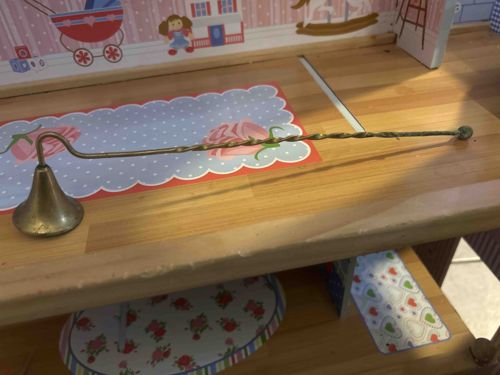
This item is a brass candle snuffer, characterized by its long, slender handle and conical snuffer bell. The overall length appears to be approximately 8-10 inches, based on its proportion to the visible dollhouse setting. The primary material is brass, exhibiting a dull, aged golden-brown patina, consistent with oxidation over time, rather than a polished, shiny finish. The snuffer bell itself is a classic conical shape, smooth and unadorned, attached to the handle by a bent L-shaped arm, suggesting it swivels freely or has a fixed angle for extinguishing flames. A distinctive feature is the handle, which transitions from a smooth, straight section near the snuffer to a dramatically twisted or spiraled section mid-shaft, creating an interesting tactile and visual element. The twisting appears uniform and intentional, indicative of a decorative manufacturing process. The very end of the handle terminates in a small, spherical knob or finial, which provides a comfortable grip and a finished look. There are no obvious maker's marks or signatures visible from the provided image. The condition shows general wear commensurate with age and use, including scuffs and scratches on the brass surface, enhancing its antique aesthetic. The patina is uneven in some areas, suggesting interaction with hands or cleaning attempts over its lifetime. No significant damage such as dents, breaks, or repairs are immediately apparent, indicating a well-preserved piece. The style points towards an older, possibly Victorian or early 20th-century aesthetic, known for incorporating decorative elements into utilitarian objects. The craftsmanship appears solid and functional for its intended purpose.
AI Appraisal Report
Based on my visual examination of the provided image, this brass candle snuffer presents as an authentic period piece, likely dating from the late 19th to early 20th century, given its style and construction. The overall condition appears good, with a well-developed, uneven patina consistent with age and use, rather than recent manufacture. The twisted handle and spherical finial are charming decorative elements. I observe general wear in the form of scuffs and scratches, which contribute to its antique character. Crucially, there are no visible signs of significant damage such as dents, breaks, or repairs that would drastically diminish its value.
From a market perspective, candle snuffers, while quaint, are generally not high-value items unless they possess exceptional provenance, intricate designs, or originate from a highly sought-after maker. This example is a good, solid utilitarian piece with decorative flair. Demand for such common brass antiques is steady but not particularly strong, placing it in a category of accessible collectibles. Comparables on online auction sites and antique marketplaces typically range from $25 for simpler examples to $100 for more ornate or unique pieces. The lack of maker's marks or distinct rarity limits its potential at the higher end of this range.
Factors impacting its value positively include its good condition relative to age, the appealing twisted handle design, and its functional integrity. Negatively, the absence of any identifying marks and high market saturation of similar items keep its value moderate. For full authentication and a more precise valuation, a physical inspection would be crucial. This would allow for an assessment of the brass alloy, manufacturing techniques, and to meticulously check for any subtle repairs or alterations not visible in photographs. Furthermore, handling the item can sometimes reveal maker's marks hidden under patina or in less obvious locations, along with providing a more accurate confirmation of its age and originality beyond stylistic cues.