AI estimate as of August 11, 2025 · verify with a professional before acting
AI-Generated · Verify before acting
Everything on this page is generated by AI for informational purposes only. AI can make mistakes — the AI may misidentify items or misattribute them (artist, maker, brand, designer, origin, era). This is not an official valuation and should not be used for insurance, sale, tax, estate, legal, or lending purposes — or any decision requiring a certified appraisal. It is not an authoritative claim about any person, brand, or rights holder — do not share or rely on it as a factual statement about a third party. Always consult qualified professionals before making financial decisions.
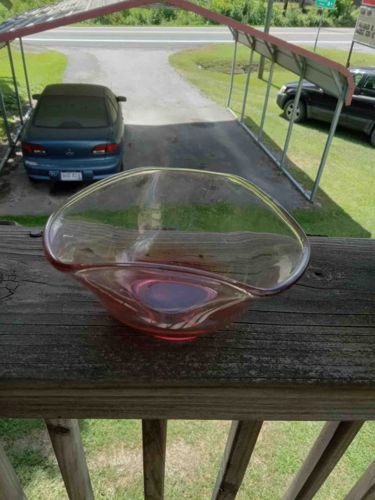
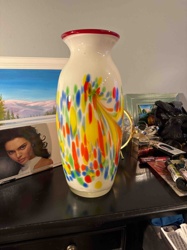
This item is a decorative art glass bowl, likely a centerpiece or serving bowl, characterized by its distinctive mid-century modern aesthetic. Its primary material is glass, exhibiting a clear top portion that transitions into a vibrant, deep cranberry or ruby red color towards the base and central depression. The bowl features an organic, somewhat asymmetrical, biomorphic shape with graceful curves that flare upwards at the ends, creating a shallow dish. The overall form suggests an elongated oval or a stylized leaf, with the sides gently rising. A notable design element is the central, slightly deeper depression which is distinctly red, contrasting with the clearer, lighter-pink tinted rim. The glass appears to be hand-blown or molded, evidenced by the smooth, fluid lines and the subtle color variations within the glass itself, indicating potential layering or specific techniques, possibly cased glass. There are no immediate visible chips, cracks, or significant damage, suggesting it is in good, used condition. The surface appears polished and free from heavy scratching, though minor wear consistent with age and handling might be present upon closer inspection. No clear maker's marks, signatures, or stamps are discernible from the image. Given its design and coloration, it strongly aligns with mid-20th century Venetian or Scandinavian art glass styles, potentially dating from the 1950s to 1970s. The thickness of the glass contributes to its apparent durability and quality. The craftsmanship seems high, with a clean finish and well-formed edges, reflecting typical quality for decorative art glass of that era.
AI Appraisal Report
Based on my visual examination, this Mid-Century Modern Cranberry Art Glass Centerpiece Bowl appears to be in very good, pre-owned condition. The organic, biomorphic shape and striking cranberry-to-clear color transition are highly characteristic of art glass produced in the 1950s-1970s, aligning with styles from Italy (e.g., Murano) or Scandinavia. The fluid lines and color variations suggest hand-blown or cased glass techniques, indicating quality craftsmanship. I detect no visible chips, cracks, or significant abrasions from the image, though minor surface wear consistent with age and handling is probable and would require in-person inspection.
Market conditions for vintage art glass, particularly well-designed Mid-Century Modern pieces, remain stable with consistent demand. Comparable pieces by renowned makers (like Empoli, Murano, or various Scandinavian studios) in excellent condition typically fetch higher prices. Without a discernible maker's mark, attribution remains speculative. The lack of a definitive maker or designer will temper value slightly, as collectors often prioritize signed or attributed works. The bowl's utility and aesthetic appeal as a centerpiece contribute positively to its desirability.
Limitations: My assessment of condition is based solely on visual cues from the image; a physical inspection is essential to confirm the absence of subtle damages, internal flaws, specific glass techniques (e.g., cased, controlled bubbles), and to verify weight and feel. Authenticity to a specific maker cannot be confirmed without a signature, original tags, or provenance documentation. Scientific testing, such as spectroscopy, is not typically performed on such items for authentication but could potentially clarify glass composition if ever deemed necessary for extreme value items.