AI estimate as of September 12, 2025 · verify with a professional before acting
AI-Generated · Verify before acting
Everything on this page is generated by AI for informational purposes only. AI can make mistakes — the AI may misidentify items or misattribute them (artist, maker, brand, designer, origin, era). This is not an official valuation and should not be used for insurance, sale, tax, estate, legal, or lending purposes — or any decision requiring a certified appraisal. It is not an authoritative claim about any person, brand, or rights holder — do not share or rely on it as a factual statement about a third party. Always consult qualified professionals before making financial decisions.
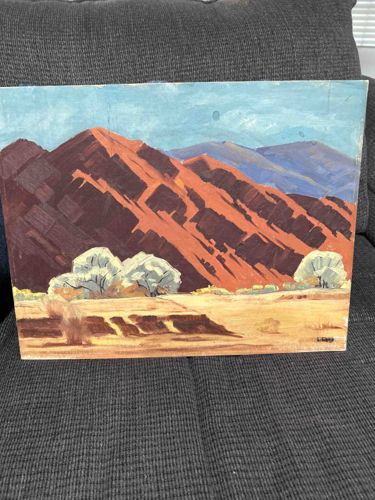
This item is an unframed painting depicting a desert landscape, executed on a rigid board likely made of wood or masonite. The painting features a prominent range of red-orange mountains in the mid-ground, characterized by strong, sharp angles and geometric planes, suggesting a stylized or somewhat abstract expression. Behind these, a second range of mountains appears in muted blues and purples, receding into the distance under a pale blue sky. In the foreground, the landscape is bathed in shades of yellow and ochre, representing desert earth. Several light-colored, possibly white or very pale green, bushy trees are depicted, adding visual interest and breaking the horizontal lines of the foreground. There appears to be a smaller, darker brown area in the immediate foreground, possibly indicating shadows or a change in terrain. The overall palette is dominated by earthy tones, vibrant reds, and cool blues. The brushstrokes are visible and appear somewhat loose, contributing to the expressive quality of the piece. There are visible areas of cosmetic wear including what appear to be small dark spots or possibly mildew on the light blue sky area. The edges of the board show some minor scuffing and wear consistent with an unframed piece that has been handled over time. In the lower right corner, there is a visible signature or marking, partially obscured but appearing to be 'L. KING' or similar. Based on the style and general appearance, the painting likely dates from the mid-20th century, possibly 1950s-1970s, reflecting a regionalist or perhaps a slightly modern art aesthetic. The craftsmanship suggests a competent hand, though the work appears to be a decorative piece rather than a fine art masterpiece, offering a charming representation of a desert scene.
AI Appraisal Report
Upon examining this 'Desert Landscape Painting on Board,' I assess its condition as fair to good. The visible cosmetic wear, specifically the small dark spots (likely mold or mildew) on the sky and minor scuffing on the board edges, are consistent with an unframed piece from the mid-20th century that has been handled over time. The overall integrity of the paint layer appears stable. Authenticity, based solely on the visual of the partially obscured 'L. KING' signature, is difficult to confirm without further investigation. While the style aligns with mid-century regionalist or decorative art, a definitive attribution would require in-person examination of the signature and paint consistency.
Market conditions for such decorative landscape paintings from lesser-known artists are generally stable but not highly speculative. Comparables in this category typically sell in the low hundreds, often driven by aesthetic appeal rather than artistic provenance. Demand exists among those seeking vintage decorative art or specific desert-themed pieces, but rarity is not a significant factor here; similar works are common in the secondary market. The fact that it's on board and unframed contributes to its more casual, decorative appeal. The noted cosmetic issues somewhat depress its value, though they are potentially remediable.
Limitations in authenticity verification are significant based solely on images. Full authentication would require a hands-on examination to analyze the paint layer, board material, and the signature's application. Provenance documentation (e.g., prior sales records, exhibition history) or scientific testing of the pigments could also confirm dating and artist attribution. Without these, it remains a charming decorative piece rather than a fine art investment.