These notes were written by the person who submitted this item. Appraiser.AI has not verified them, and the AI's identification and estimate may rely on them.
AI Estimated Value
Not an official valuation
$250-450
AI estimate as of September 18, 2025 · verify with a professional before acting
AI-Generated · Verify before acting
Everything on this page is generated by AI for informational purposes only. AI can make mistakes — the AI may misidentify items or misattribute them (artist, maker, brand, designer, origin, era). This is not an official valuation and should not be used for insurance, sale, tax, estate, legal, or lending purposes — or any decision requiring a certified appraisal. It is not an authoritative claim about any person, brand, or rights holder — do not share or rely on it as a factual statement about a third party. Always consult qualified professionals before making financial decisions.
This analysis also relies on unverified notes provided by the user, which may be incomplete or inaccurate and could affect the result.
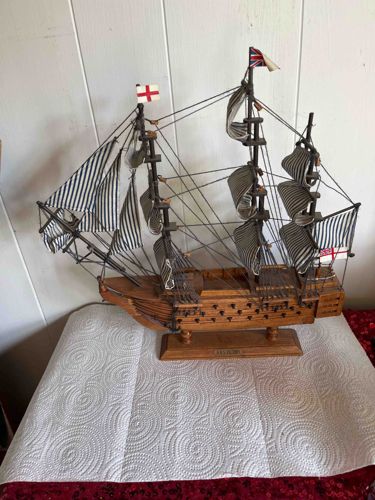
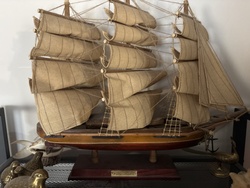
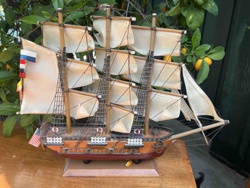
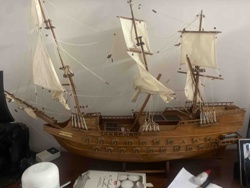
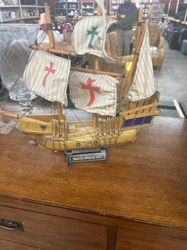
This is a detailed scale model of a historical sailing ship, likely representing the HMS Victory given the naval ensigns. The model is predominantly constructed from wood, exhibiting a rich, warm brown finish on the hull and deck. The hull features multiple rows of painted gunports, suggesting a warship design. The intricate rigging is crafted from dark-colored threads, meticulously connecting the masts and spars. The sails are made of a light-colored fabric, possibly cotton or linen, with distinct black and white vertical stripes, appearing furled or partially furled, adding to the dynamic presentation. Visible flags include a Red Ensign (St. George's Cross) at the stern mast and a Union Jack at the main mast, indicating its British identity. The craftsmanship appears to be of moderate quality, with attention paid to the details of the rigging and hull ornamentation. There are no obvious signs of significant wear, damage, or repairs, though some dust accumulation is possible. The model rests securely on a rectangular wooden base, also finished in a coordinating warm brown tone. The overall condition appears good. Based on the style and general construction, this model likely dates from the late 20th century to early 21st century and serves as a decorative item rather than a precise historical replica for museum-quality display.
AI Appraisal Report
Upon examining the provided image and description of this HMS Victory Model Ship, I assess its condition as good. The model appears to be predominantly well-preserved, with no obvious signs of significant wear, damage, or repairs—a favorable aspect for its value. The stated good condition, coupled with the wooden construction and intricate rigging, indicates a degree of craftsmanship that places it above mass-produced plastic models. The presence of a coordinating wooden base further enhances its presentation and stability. However, the presence of dust accumulation, though minor, suggests a need for gentle cleaning.
Authenticity, in terms of its representation as HMS Victory, is indicated by the naval ensigns (Red Ensign and Union Jack). However, I must note the limitation that an in-person examination would be crucial to definitively assess the quality of construction materials, the precision of the rigging, and the overall artistic execution, which are difficult to ascertain from images alone. The description suggests it is a decorative item rather than a museum-quality replica, which aligns with typical market demand for detailed, yet accessible, model ships.
Market conditions for decorative model ships of this nature are stable, with demand primarily driven by enthusiasts of nautical history and interior decor. This model is not rare; similar decorative models are frequently available through online retailers, antique shops, and auction platforms. The overall craftsmanship, while moderate, positions it within a mid-range market segment. Factors impacting its value negatively include the likelihood of it being a later 20th to early 21st-century decorative piece rather than an antique, and the general availability of comparable items. Conversely, its perceived good condition and attention to detail positively influence its appeal.
To conduct a full authentication and more precise valuation, a physical inspection would be essential to verify material quality, construction integrity, and scale accuracy. Provenance documentation, if available, could also provide insights into its maker and history, potentially impacting its collectibility and value.