AI estimate as of September 19, 2025 · verify with a professional before acting
AI-Generated · Verify before acting
Everything on this page is generated by AI for informational purposes only. AI can make mistakes — the AI may misidentify items or misattribute them (artist, maker, brand, designer, origin, era). This is not an official valuation and should not be used for insurance, sale, tax, estate, legal, or lending purposes — or any decision requiring a certified appraisal. It is not an authoritative claim about any person, brand, or rights holder — do not share or rely on it as a factual statement about a third party. Always consult qualified professionals before making financial decisions.
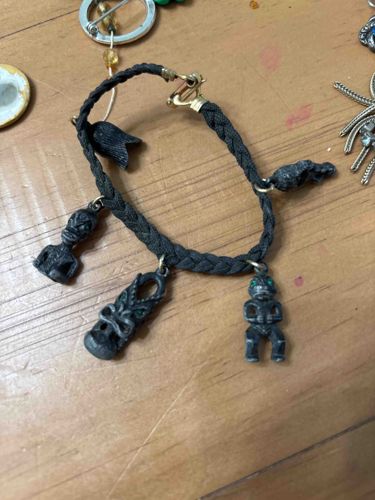
This item is a charm bracelet featuring a main band constructed from tightly braided black cord. The cord appears to be textile, possibly cotton or a synthetic fiber, exhibiting a consistent and even braid throughout its length. The bracelet is secured by a gold-toned metal clasp, possibly a spring ring clasp or similar, attached to the braided cord ends via small jump rings. Several charms are suspended from the braided cord at various points. These charms are predominantly dark-colored, appearing to be crafted from a material such as pewter, oxidized silver, or a dark-colored resin/plastic. They depict various primitive or tribal-style figurative motifs. One charm is a full-bodied human-like figure with defined features and what appear to be small green inlays for eyes. Another charm is a more abstract, elongated tiki or mask-like face motif with intricate carved or molded details. A third charm is a somewhat amorphous, dark-colored object on the opposite side of the bracelet, whose exact form is less clear but also appears to be figurative. There is another similar, smaller, darker charm hanging near the clasp. The overall aesthetic suggests an ethnic, tribal, or bohemian style. The primary color scheme is black and dark grey/bronze with minor green accents. The craftsmanship appears to be commercial, likely an affordable fashion jewelry piece. Visible condition issues include some general wear consistent with use, such as minor scuffing on the charms and slight fraying of the braided cord, though these are not severe. The gold-toned clasp shows no obvious tarnishing in the image. The estimated age would be contemporary or mid-to-late 20th century. No discernible maker's marks or signatures are visible in the provided images.
AI Appraisal Report
I have examined the provided image of this Braided Cord Charm Bracelet with Figurative Charms. The bracelet features a tightly braided black textile cord, secured by a gold-toned metal clasp. Several dark-colored, primitive/tribal-style figurative charms are suspended from the cord, including a human-like figure with green inlays, an abstract tiki/mask-like face, and other amorphous forms. The overall aesthetic points to an ethnic, tribal, or bohemian style, likely contemporary or mid-to-late 20th century. Based on the visual evidence, the craftsmanship appears commercial, suggesting an affordable fashion jewelry piece. I note general wear consistent with use, such as minor scuffing on the charms and slight fraying of the cord, indicating it is a pre-owned item but not severely damaged. The gold-toned clasp appears untarnished.
Market conditions for such contemporary fashion jewelry are generally stable but with low values. Comparables would include similar braided cord or leather bracelets with base metal or resin charms, often found in retail stores, craft fairs, or online marketplaces. Demand is modest, typically driven by individuals seeking casual, trend-driven accessories. Rarity is not a factor here; items of this type are mass-produced. Factors significantly impacting value are the non-precious materials and commercial production. Without maker's marks or provenance, and given the materials, this is valued as decorative costume jewelry.
A significant limitation in authenticity verification from images alone is the inability to ascertain precise material composition (e.g., specific metal alloy of the clasp, material of the charms) or confirm the origin definitively. An in-person examination would allow for tactile assessment of material quality, weight, and detailed inspection for any subtle maker's marks not visible in the image. Scientific testing (e.g., XRF for metal composition) would be needed for absolute verification, though it is not warranted for an item of this value.