AI estimate as of August 28, 2025 · verify with a professional before acting
AI-Generated · Verify before acting
Everything on this page is generated by AI for informational purposes only. AI can make mistakes — the AI may misidentify items or misattribute them (artist, maker, brand, designer, origin, era). This is not an official valuation and should not be used for insurance, sale, tax, estate, legal, or lending purposes — or any decision requiring a certified appraisal. It is not an authoritative claim about any person, brand, or rights holder — do not share or rely on it as a factual statement about a third party. Always consult qualified professionals before making financial decisions.
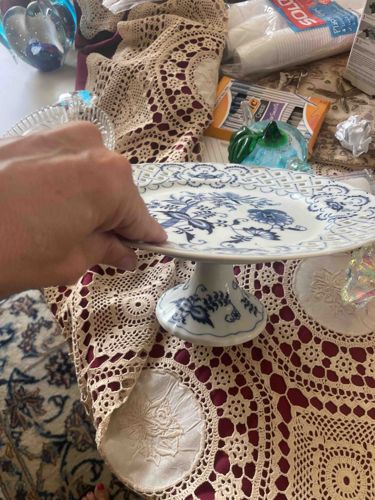
The item is a ceramic cake stand or compote, featuring an intricate blue and white pattern commonly known as 'Blue Onion' or 'Zwiebelmuster'. The stand consists of a flat, circular plate top elevated by a central, fluted or trumpet-shaped base. The plate's rim has a detailed lattice-like border, while the central field of the plate is adorned with the characteristic blue onion pattern, depicting stylized pomegranates and other floral motifs. The base of the stand also showcases elements of the blue onion design. The primary colors are crisp white and various shades of cobalt blue. The material appears to be porcelain or fine ceramic, indicative of quality craftsmanship. No obvious significant damage like chips or cracks are visible, suggesting it is in good condition, though a full inspection for subtle crazing or minor wear would be necessary for appraisal. The glaze appears glossy and intact. The design is a classic, enduring pattern, often associated with manufacturers like Meissen (who originated the pattern), Hutschenreuther, or Rosenthal, suggesting a potential age from the late 19th to mid-20th century, though modern reproductions exist. Without a visible maker's mark, specific manufacturing details are speculative. The item's proportions seem suitable for serving desserts or displaying fruits, and its aesthetic quality suggests it might be a decorative as well as functional piece.
AI Appraisal Report
This Blue Onion pattern ceramic pedestal cake stand presents as an elegant piece of dinnerware/serveware. Visually, the condition appears excellent, with no apparent chips, cracks, or significant wear to the vibrant blue and white glaze. The glossy finish is well-preserved, suggesting careful handling over its lifespan. The intricate 'Zwiebelmuster' design, depicting stylized pomegranates and floral motifs, hints at a potential origin from prominent manufacturers like Meissen, Hutschenreuther, or Rosenthal, who historically popularized this pattern.
Market conditions for classic Blue Onion pieces remain steady, driven by collectors and those seeking timeless elegance in their serveware. While not exceptionally rare, authentic antique or vintage pieces from established makers are sought after. Demand is consistent, particularly for larger or more unique forms like this pedestal stand. The primary factor impacting value is authenticity; without a visible maker's mark, it's difficult to definitively attribute its origin or age from images alone. The quality of the porcelain or ceramic, the sharpness of the design, and the overall craftsmanship are positive indicators.
Limitations in authenticity verification are significant. A physical in-person examination is crucial to check for subtle crazing, minor glaze imperfections, and, most importantly, to locate any hidden maker's marks or impressed numbers. Provenance documentation, if available, would provide invaluable context on its history and origin. In some cases, scientific testing of the clay body or glaze composition could help confirm age and manufacturer. However, based purely on visual assessment in the absence of these, I must consider the possibility of a high-quality reproduction, which would significantly affect value.