AI estimate as of October 23, 2025 · verify with a professional before acting
AI-Generated · Verify before acting
Everything on this page is generated by AI for informational purposes only. AI can make mistakes — the AI may misidentify items or misattribute them (artist, maker, brand, designer, origin, era). This is not an official valuation and should not be used for insurance, sale, tax, estate, legal, or lending purposes — or any decision requiring a certified appraisal. It is not an authoritative claim about any person, brand, or rights holder — do not share or rely on it as a factual statement about a third party. Always consult qualified professionals before making financial decisions.
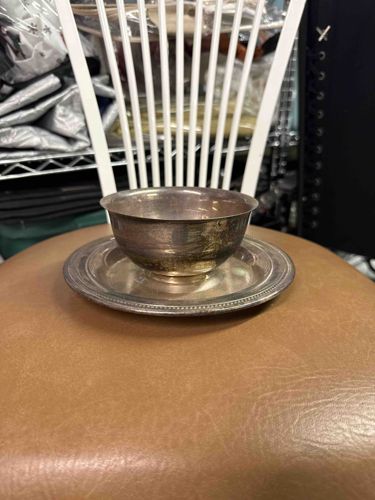
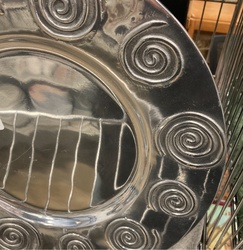
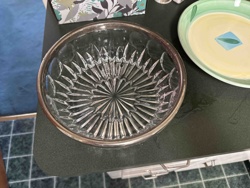
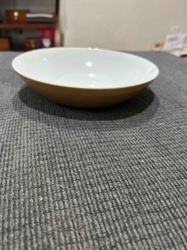
The item depicted is a silver-toned bowl and saucer set, likely crafted from silver plate or a similar alloy, given the visible tarnishing. The bowl is small and smoothly curved, appearing to be a shallow dish or perhaps a sugar bowl, while the saucer is flat with a raised rim designed to hold the bowl securely. Both pieces exhibit a metallic, reflective surface that is currently dulled by oxidation, presenting a dark, mottled patina across large sections of their exteriors and interiors. The saucer features a distinct decorative border around its edge, composed of a series of small, raised dots or beads, adding a touch of classical or early 20th-century aesthetic. The overall construction appears solid, with no immediate signs of significant dents or structural damage, though the surface shows numerous scratches and scuffs consistent with regular use and age. The presence of significant tarnish suggests a material that reacts with air, typical of silver or silver-plated items that have not been recently polished. The design indicates it could have been part of a tea set, a snack set, or a condiment serving collection. Without clearer images of the underside, specific manufacturer's marks or hallmarks are not discernible, which would be crucial for determining the precise material content and origin. The item likely dates from the late 19th to mid-20th century, a period when such decorative metalware was commonly produced. Its condition, while showing age, retains its original form and functionality, indicating a need for professional cleaning and polishing to restore its luster.
AI Appraisal Report
I have examined the image of this silver-toned bowl and saucer set. Visually, the set appears to be silver plate due to the significant and uneven tarnishing, which is characteristic of plated items that have not been maintained. The construction seems solid, and despite the dullness from oxidation, the forms of both the small, shallow bowl and the flat saucer with its raised rim are intact. The saucer's decorative beaded border suggests a late 19th to mid-20th-century origin, a period prolific for such domestic metalware. While there are numerous scratches and scuffs consistent with age and use, I do not observe any major dents or structural damage in the image. This indicates that with proper cleaning and polishing, its aesthetic appeal could be largely restored.
From a market perspective, comparable silver-plated bowl and saucer sets, especially those lacking prominent maker's marks or significant decorative artistry, tend to fetch modest prices. Demand for such items is generally stable, driven by collectors of vintage home goods or those looking for functional, aesthetically pleasing serving pieces. However, the lack of rarity and the commonality of silver-plated items from this era prevent high valuations. The main factors impacting its current value negatively are the extensive tarnish and surface wear. Its authenticity as an antique or vintage silver-plated item is plausible through visual inspection alone due to the characteristic tarnish.
However, a definitive appraisal would necessitate in-person examination to confirm the material (e.g., silver plate versus sterling silver, though the tarnish strongly suggests plate), identify any hallmarks or maker's marks, and fully assess the extent of surface damage. Without physical inspection, I cannot confirm the exact material composition, specific manufacturer, or precise age. Provenance documentation would further corroborate its history. Based on the visual evidence, I estimate its value in its current unpolished condition to be in the range of $40 to $70.