AI estimate as of August 14, 2025 · verify with a professional before acting
AI-Generated · Verify before acting
Everything on this page is generated by AI for informational purposes only. AI can make mistakes — the AI may misidentify items or misattribute them (artist, maker, brand, designer, origin, era). This is not an official valuation and should not be used for insurance, sale, tax, estate, legal, or lending purposes — or any decision requiring a certified appraisal. It is not an authoritative claim about any person, brand, or rights holder — do not share or rely on it as a factual statement about a third party. Always consult qualified professionals before making financial decisions.
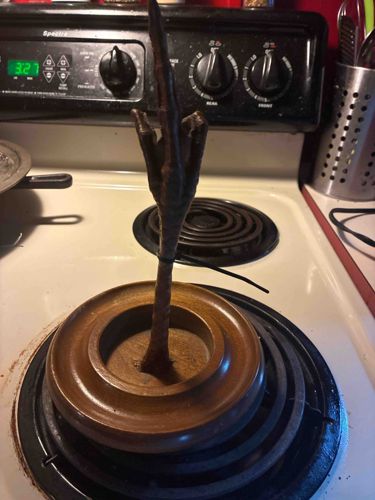
This item is a novelty decorative piece, likely a stand or holder, featuring what appears to be a preserved or taxidermied bird's foot mounted vertically on a dark, possibly stained, circular wooden base. The bird's foot is dark brown to black in color, suggesting either a natural dark pigmentation, a preservation treatment, or significant aging. The talons are visible and appear sharp, typical of a raptor or similar bird of prey. The foot itself is elongated, forming the central upright element of the piece. Around the base of the foot, where it enters the wooden stand, there appears to be a binding, possibly wire or twine, that is dark and blends with the foot, suggesting it secures the foot to a hidden internal rod that anchors it to the base. The wooden base is circular, with a central recessed area where the bird's foot is mounted. It has a warm, medium-brown finish, likely a stained hardwood, and displays a notable sheen, indicating a polished or varnished surface. The base shows some signs of wear, particularly around the edges and on the flat surface, including minor scuffs or dust accumulation, but no significant cracks or chips are visible. The craftsmanship appears to be folk art or a curiosity, rather than mass-produced, given the organic, irregular shape of the bird's foot and the generally utilitarian nature of the mount. It likely dates from the mid-20th century or earlier, when such 'curiosities' were more commonly collected or displayed. There are no discernible maker's marks or signatures visible in the image. Its unique and somewhat macabre nature makes it a conversation piece.
AI Appraisal Report
I have examined the provided image of what appears to be a Bird's Foot Novelty Mount or Stand. My assessment of its condition, based solely on visual evidence, suggests it is in good, albeit aged, condition. The bird's foot itself seems well-preserved, with visible talons that suggest a raptorial origin. The dark coloration is consistent with natural aging, preservation treatments, or pigment. The circular wooden base shows minor wear, scuffs, and dust accumulation, but no significant damage like cracks or chips, and retains a visible sheen. Authenticity, based on an image, is limited; the piece strongly aligns with historical 'curiosity' or 'natural history' items popular in the mid-20th century or earlier. The craftsmanship appears artisanal rather than mass-produced.
Market conditions for such novelty curios are niche. Comparables are scarce and typically surface in online auctions or specialized antique shops. Demand is driven by collectors of oddities, taxidermy, or unique decorative objects. While not exceedingly rare, original pieces like this, especially those in good condition, are not common. Factors significantly impacting value include its genuine age, the species of bird (if identifiable), and overall preservation.
Limitations in authenticity verification from images are considerable. Without physical inspection, I cannot confirm the true material of the 'foot' (e.g., bone vs. taxidermy), the integrity of the mount, or the true age of the components. A full authentication would require in-person examination to assess the preservation method, detailed material analysis, and potentially provenance documentation confirming its origin and history. Scientific testing, such as carbon dating or DNA analysis, could definitively establish the age and species, significantly impacting value.