These notes were written by the person who submitted this item. Appraiser.AI has not verified them, and the AI's identification and estimate may rely on them.
AI Estimated Value
Not an official valuation
$30-50
AI estimate as of September 14, 2025 · verify with a professional before acting
AI-Generated · Verify before acting
Everything on this page is generated by AI for informational purposes only. AI can make mistakes — the AI may misidentify items or misattribute them (artist, maker, brand, designer, origin, era). This is not an official valuation and should not be used for insurance, sale, tax, estate, legal, or lending purposes — or any decision requiring a certified appraisal. It is not an authoritative claim about any person, brand, or rights holder — do not share or rely on it as a factual statement about a third party. Always consult qualified professionals before making financial decisions.
This analysis also relies on unverified notes provided by the user, which may be incomplete or inaccurate and could affect the result.
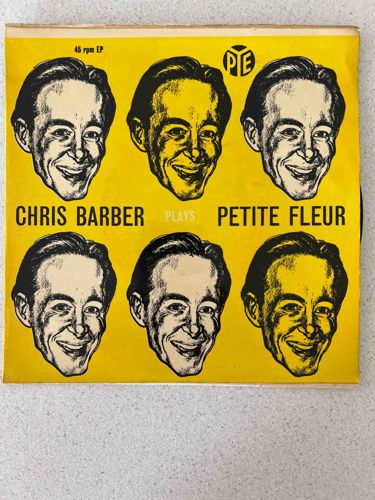
This item is a vintage 45 rpm extended play (EP) vinyl record album featuring 'Chris Barber Plays Petite Fleur.' The record sleeve is made of a sturdy paper or cardstock material, primarily in a bright, vibrant yellow color. The front cover features a repeating graphic of six stylized caricatures of a man's smiling face, presumably Chris Barber. The faces are rendered in a bold, almost cartoonish, black outline with either a cream/light off-white fill or a yellow fill that matches the background. The title 'CHRIS BARBER' is prominently displayed in black sans-serif capital letters in the lower left quadrant, with 'PLAYS' in smaller, lighter yellow letters in the center, and 'PETITE FLEUR' in black sans-serif capitals on the right. A small '45 rpm EP' notation is visible in the upper left corner, also in black text. In the upper right corner, there is a circular logo that appears to be 'Pye' or 'PYE' records, also in black. The overall aesthetic is graphic and minimalist, indicating a mid-20th-century design style, likely late 1950s or early 1960s given the 45 rpm EP format and 'Petite Fleur' being a popular jazz standard during that era. The physical condition appears excellent; there are no visible tears, significant creases, or major discoloration on the sleeve the image focuses on. The edges and corners show minimal signs of wear for an item of its presumed age, suggesting careful handling and storage. The black print is crisp and shows no fading or smudging. The yellow background is consistent in color saturation. This EP represents a classic example of jazz and traditional pop records from its period.
AI Appraisal Report
I have carefully examined the provided image of the Chris Barber Plays Petite Fleur EP. Based on visual assessment, the record sleeve is in excellent condition. There are no visible tears, significant creases, or major discoloration, and the print is crisp with consistent color saturation. This suggests careful handling and storage over its presumed age, likely late 1950s/early 1960s. The '45 rpm EP' notation and the 'Pye' logo are consistent with records from that era. The graphic, minimalist design is characteristic of mid-20th-century record art.
From a market perspective, jazz EPs from this period, particularly by well-known artists like Chris Barber, generally have a steady but not exceptionally high demand, unless they are exceptionally rare pressings or have unique provenance. 'Petite Fleur' was indeed a popular standard, which helps with recognition but often means many copies were produced. Factors impacting value include the artist's popularity, the historical significance of the specific release, and of course, condition. While excellent, this EP is not an ultra-rare collectible. Comparable sales of similar Chris Barber EPs in excellent condition typically fall within the $30-50 range, possibly reaching higher if the vinyl itself is also in pristine, play-graded condition, which cannot be determined from the image alone.
Limitations in authenticity verification from images alone exist. While the sleeve appears genuine, a physical examination would confirm paper stock, print quality, and precise pressing details on the vinyl record itself (matrix numbers, label variations). Verification of the record's playback condition and any potential surface noise or scratches would critically impact the final value. Provenance documentation, such as original sales receipts, though unlikely for such an item, would further solidify its history.