AI estimate as of November 10, 2025 · verify with a professional before acting
AI-Generated · Verify before acting
Everything on this page is generated by AI for informational purposes only. AI can make mistakes — the AI may misidentify items or misattribute them (artist, maker, brand, designer, origin, era). This is not an official valuation and should not be used for insurance, sale, tax, estate, legal, or lending purposes — or any decision requiring a certified appraisal. It is not an authoritative claim about any person, brand, or rights holder — do not share or rely on it as a factual statement about a third party. Always consult qualified professionals before making financial decisions.
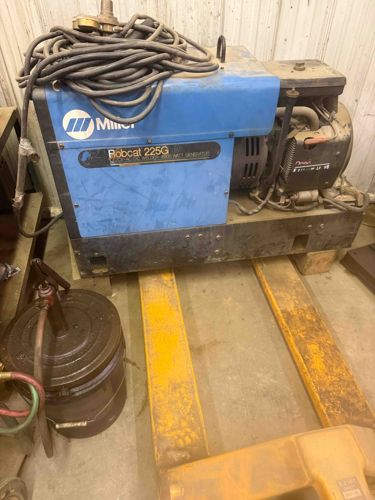
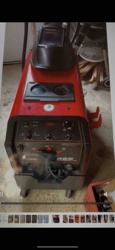
The item is a Miller Bobcat 225G welder/generator, a robust piece of industrial equipment primarily designed for welding and providing auxiliary power. The unit features a distinctive blue housing, characteristic of Miller Electric manufacturing, with a black base and engine components. It appears to be constructed predominantly from painted sheet metal for the main casing, with cast metal or heavy-gauge steel for the structural base and internal engine components. The branding 'Miller' and 'Bobcat 225G' are clearly visible on the side panel in white lettering. The machine is rectangular in shape, appearing quite heavy-duty, suggesting it is built for demanding work environments.
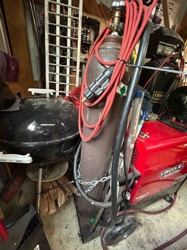
Numerous cables, likely welding leads and power cords, are coiled untidily on top of the blue housing, indicating regular use. There's significant dust and grime accumulation across the entire unit, particularly noticeable on the top and engine compartments, suggesting it has been used in a dirty or industrial setting and has not been recently cleaned. The paint on the blue housing shows some scuffs, scratches, and discoloration, consistent with wear and tear over time. The exposed engine components on the right side are dark and show signs of use, including some oil residue or staining. The unit is resting on the forks of a yellow pallet jack or similar lifting equipment, which itself appears weathered and corroded, especially on the yellow painted surfaces of the forks. The overall aesthetic suggests a piece of machinery that is functional but has seen considerable use. No obvious major damage like cracks or broken parts are visible, but the general appearance indicates a need for cleaning and potentially some maintenance.
AI Appraisal Report
Upon visual examination of the provided image, I have assessed this Miller Bobcat 225G Welder/Generator. Authenticity is strongly supported by the clear 'Miller' and 'Bobcat 225G' branding, characteristic blue housing, and overall design consistent with Miller Electric products. However, without a physical inspection, I cannot confirm serial numbers or internal component originality, which could impact full authentication.
The condition appears to be 'fair to good' based on the visible wear. The significant dust, grime, and surface scuffs on the blue housing indicate considerable use in an industrial environment and a lack of recent cleaning. While no major structural damage like cracks or broken parts is apparent, the untidy cables and engine residue suggest the unit has not been meticulously maintained. A physical inspection would be necessary to assess engine health, electrical system integrity, and weld performance.
In terms of market conditions, Miller Bobcat 225G units are generally sought after due to their dual functionality and Miller's reputation for durability. There is consistent demand for used welder/generators, especially models known for reliability. While not rare, the 'Bobcat 225G' maintains strong resale value. Comparables for well-maintained used units typically range from $1,500 to $2,500, with new models exceeding $4,000.
The primary factors affecting this appraisal are the visible cosmetic wear and the implied lack of recent maintenance, which suggests potential functional issues that can only be verified through testing. The current dusty state reduces its immediate market appeal.
For full authentication and a definitive value, an in-person examination is crucial. This would involve inspecting internal components, testing engine start-up and operation, verifying welding output, checking all electrical connections, and confirming serial numbers against manufacturing records. Provenance documentation, such as purchase records or service history, would also add significant value and verify authenticity beyond visual aspects.