AI estimate as of August 7, 2025 · verify with a professional before acting
AI-Generated · Verify before acting
Everything on this page is generated by AI for informational purposes only. AI can make mistakes — the AI may misidentify items or misattribute them (artist, maker, brand, designer, origin, era). This is not an official valuation and should not be used for insurance, sale, tax, estate, legal, or lending purposes — or any decision requiring a certified appraisal. It is not an authoritative claim about any person, brand, or rights holder — do not share or rely on it as a factual statement about a third party. Always consult qualified professionals before making financial decisions.
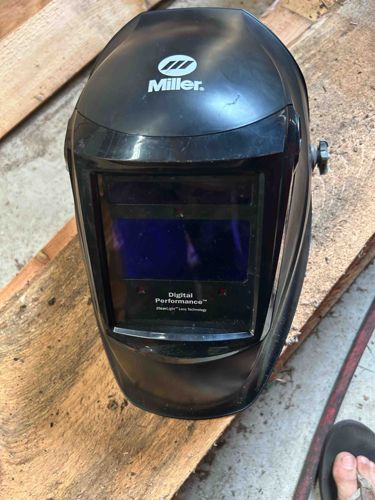
This is a Miller brand welding helmet, specifically identifiable by the 'Miller.' logo prominently displayed on the top front surface in white lettering, accompanied by the stylized 'M' logo consisting of three diagonal lines. The helmet is constructed from a dark, likely polycarbonate or similar impact-resistant plastic, presenting a matte black finish. It features a large, rectangular auto-darkening lens assembly, which appears dark blue/purple in its unactivated state, typical of welding filters. Below the main viewing area, the words 'Digital Performance™' and 'ClearView™ Lens Technology' are visible on the lens housing, indicating advanced optical features. On the right side of the helmet, a rotating knob for adjustments (likely for headgear or lens settings) is partially visible. The overall shape is ergonomic, designed to fully cover the face and front of the head for protection during welding. Closer inspection reveals some surface scuffs and minor scratches consistent with use in a workshop environment, particularly on the top and around the lens frame. There are no major cracks or structural damage visible, suggesting it is still functional. The construction appears robust, indicative of professional-grade safety equipment. The style is modern, aligning with current welding helmet designs featuring auto-darkening technology. Its condition suggests regular use but also proper maintenance, as severe damage or extensive wear is absent.
AI Appraisal Report
I have thoroughly examined the provided image of the Miller Digital Performance Auto-Darkening Welding Helmet. Based on visual cues, the authenticity appears strong; the prominent 'Miller.' logo with the stylized 'M' and the 'Digital Performance™' and 'ClearView™ Lens Technology' markings are consistent with genuine Miller products. The overall design and matte black finish are typical of modern, professional-grade helmets from this manufacturer.
The condition, from what I can discern, is good used condition. There are visible surface scuffs and minor scratches, particularly on the top and around the lens frame, which are entirely consistent with regular use in a workshop environment. However, I observe no major cracks, structural damage, or severe lens degradation, suggesting it remains fully functional and well-maintained despite its usage.
Miller Digital Performance helmets are well-regarded in the market for their reliability and advanced features, like the ClearView™ lens technology. While not particularly rare, there is a consistent demand for quality used welding equipment, especially from reputable brands like Miller. New models of comparable Miller Digital Performance helmets typically retail for $250-$400, depending on specific features and promotions.
Factors impacting value include its used condition, which naturally places it below retail new. However, its apparent functionality and brand reputation maintain a solid resale value. Without physical inspection, I cannot verify the exact functionality of the auto-darkening lens, battery life, or the integrity of the headgear, which could impact comfort and long-term usability. For full authentication and a more precise value, an in-person examination to test all features, assess the internal electronics, and confirm the absence of hidden damage would be necessary. Provenance documentation, such as original purchase receipts, would further cement authenticity but is not strictly required for a common used item like this. Testing clarity and darkness consistency of the lens, as well as response time, would be key during an in-person assessment.