AI estimate as of August 27, 2025 · verify with a professional before acting
AI-Generated · Verify before acting
Everything on this page is generated by AI for informational purposes only. AI can make mistakes — the AI may misidentify items or misattribute them (artist, maker, brand, designer, origin, era). This is not an official valuation and should not be used for insurance, sale, tax, estate, legal, or lending purposes — or any decision requiring a certified appraisal. It is not an authoritative claim about any person, brand, or rights holder — do not share or rely on it as a factual statement about a third party. Always consult qualified professionals before making financial decisions.
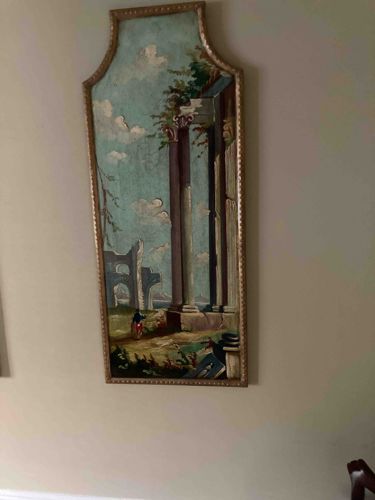
This item is a decorative painting, likely oil on canvas or board, set within a shaped, possibly gilded, wooden frame. The painting depicts a classical ruins landscape, a popular theme evoking ancient grandeur and romantic decay. The composition prominently features robust columns, some of which appear partially ruined or overgrown with foliage, suggesting a scene of historical depth. In the background, further architectural remnants, possibly arches or other structures, are visible under a sky dominated by soft blue hues and fluffy white clouds. A small figure, possibly a traveler or shepherd, is subtly integrated into the foreground, adding scale and a human element to the vast architectural setting. The color palette leans towards earthy tones for the landscape and architecture, contrasted with the brighter blues and whites of the sky. The frame has an ornate, scalloped or scrolled shape at the top, tapering down to a rectangular base, suggesting a Neo-classical or Regency revival style, possibly from the mid-20th century, though earlier periods are not entirely ruled out without further inspection. The frame itself appears to have a gold-leaf or gilded finish, which shows some visible wear and possibly slight chipping consistent with age or handling. The surface of the painting itself appears to have some patina or mild discoloration, as is common with older artworks, but no significant damage like tears or severe cracking is immediately discernible from the image. The brushwork appears somewhat detailed, contributing to a sense of depth and atmosphere. The overall craftsmanship suggests a commercially produced decorative piece rather than a fine art masterpiece, designed to complement traditional interior decor.
AI Appraisal Report
Upon visual examination of the provided image, this Classical Ruins Landscape Shaped Painting appears to be a decorative piece, likely from the mid-20th century, though earlier decorative periods cannot be entirely ruled out without physical inspection. The condition seems good for its age; I observe anticipated patina and slight discoloration on the painting's surface and minor wear, possibly chipping, on the gilded frame. No significant damage like tears or severe cracking is discernible. Authenticity-wise, based on the image, this is consistent with a mass-produced or commercially produced decorative artwork, rather than a unique art masterpiece from a renowned artist. The painting style and ornate frame suggest it was intended for traditional interior decor.
Market conditions indicate a steady, albeit modest, demand for decorative classical landscape paintings. Comparables in the secondary market, particularly those with ornate shaped frames from the mid-20th century, typically fetch prices in the low to mid-hundreds. Rarity is low as similar decorative pieces were widely produced. Factors impacting value include its decorative appeal, lack of a known artist, and the general condition.
It is crucial to note the limitations of authenticity verification from images alone. A definitive authentication would require in-person examination to assess paint quality, substrate, and frame construction details, and to identify any artist's signatures or labels. Provenance documentation, if available, would significantly enhance its value by establishing its history. Scientific testing, such as pigment analysis or carbon dating, would be necessary for precise dating and material verification, which is typically not pursued for decorative pieces of this type.