AI estimate as of August 23, 2025 · verify with a professional before acting
AI-Generated · Verify before acting
Everything on this page is generated by AI for informational purposes only. AI can make mistakes — the AI may misidentify items or misattribute them (artist, maker, brand, designer, origin, era). This is not an official valuation and should not be used for insurance, sale, tax, estate, legal, or lending purposes — or any decision requiring a certified appraisal. It is not an authoritative claim about any person, brand, or rights holder — do not share or rely on it as a factual statement about a third party. Always consult qualified professionals before making financial decisions.
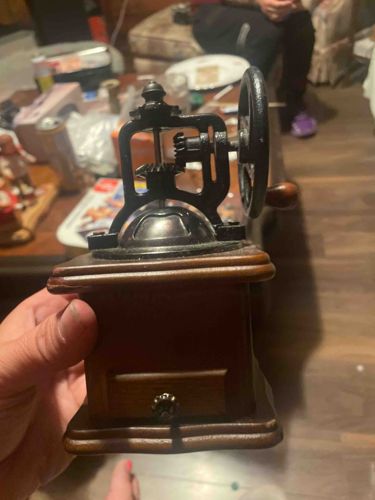
This item is a vintage-style manual coffee grinder, characterized by its traditional square wooden base and cast iron grinding mechanism. The main body is crafted from dark-stained wood, possibly oak or an equivalent hardwood, with a visibly rich, deep brown hue. The construction features clean, dovetailed or finger-jointed corners, indicating solid craftsmanship. The top surface of the wooden base is slightly recessed to accommodate the metal grinding apparatus, which appears to be made of black-painted cast iron. This mechanism includes a hopper with a domed, possibly chrome-plated or polished metal lid that covers the opening where coffee beans are inserted. A prominent large, spoked wheel on the side is attached to a handle, which, when turned, drives the internal burr grinder. Visible gears on the top structure of the cast iron assembly suggest a robust and functional design. Below the grinding mechanism, the wooden base features a small, pull-out drawer, likely designed to collect the ground coffee. This drawer is equipped with a decorative dark metal knob, possibly brass or iron, with a floral or intricate pattern, adding to the antique aesthetic. The bottom of the wooden base also has a subtly carved or rounded edge, providing a finished look. The overall condition appears good, with no overt signs of significant damage like cracks or major chipping, though minor surface wear consistent with age and use (e.g., slight scratches, patina on metal parts) is to be expected for such an item. The style suggests a late 19th to early 20th-century design influence, although many modern reproductions mimic this classic look. The quality indicators point towards a functional, well-built piece, designed for regular use, even if it is a recent reproduction. The dark wood and black metal provide a contrasting, classic aesthetic. No visible manufacturing marks or signatures are discernible from the provided images.
AI Appraisal Report
Upon visual examination of this manual coffee grinder, I observe a charming vintage-style piece. The dark-stained wooden base with what appears to be dovetailed or finger-jointed construction suggests a degree of craftsmanship, while the black-painted cast iron grinding mechanism with a spoked wheel and pull-out drawer with a decorative knob evokes a classic aesthetic. The overall condition appears good, consistent with use and age, exhibiting expected minor surface wear or patina rather than significant damage.
Authenticity is the primary challenge when appraising such an item based solely on images. While the design strongly harks back to late 19th to early 20th-century models, many modern reproductions mimic this popular style. Without direct physical examination, I cannot definitively determine if this is an authentic antique or a contemporary replica. Key indicators for in-person inspection would include evaluating the wood grain and its aging, the patina on the metal components (especially the cast iron and any chrome/polished elements), and the specific construction techniques and hardware for consistency with known antique methods. The presence or absence of manufacturer marks or patent numbers, often found on true antiques, is also critical. Provenance documentation, such as original sales receipts or family history, would significantly aid in authentication.
Factors impacting value include its demonstrable functionality (if it grinds coffee effectively), aesthetic appeal, and, crucially, its authenticity. If proven to be a genuine late 19th to early 20th-century antique in good working order, demand among collectors of kitchenalia would be moderate to high. However, if it's a modern reproduction, its value would largely be based on its decorative appeal and utility as a functional grinder. Comparable antique grinders range widely, from decorative pieces at $50-$150 to rare, high-quality, or branded examples fetching several hundred. Modern reproductions typically retail for $30-$100.
Given the limitations of image-only appraisal, and unable to verify its antique status, I must base my appraisal on its most conservative interpretation as a well-made vintage-style or reproduction piece with good decorative and functional qualities.