AI Appraisal Estimate

AI-generated estimates · not official valuations

From the user

What was submitted

Photo and notes provided by the user — not generated by AI

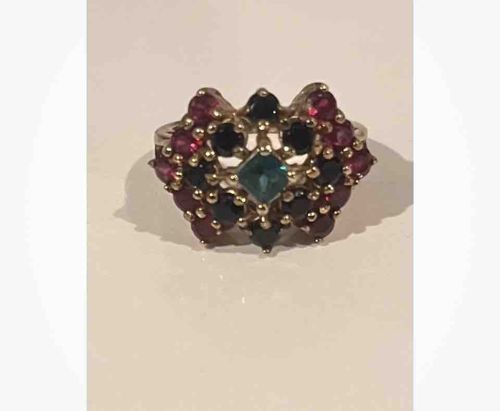
Submitted item photo
Submitted photo · June 10, 2026

User's notes

No additional notes provided.

AI analysis below

AI appraisal

AI analysis & estimate

AI-Generated · Verify before acting

Everything below is generated by AI for informational purposes only. AI can make mistakes — the AI may misidentify items or misattribute them (artist, maker, brand, designer, origin, era). This is not an official valuation and should not be used for insurance, sale, tax, estate, legal, or lending purposes — or any decision requiring a certified appraisal. It is not an authoritative claim about any person, brand, or rights holder — do not share or rely on it as a factual statement about a third party. Always consult qualified professionals before making financial decisions.

Read the full disclaimer

AI Identification

·Not independently authenticated·Verify before acting

Vintage Multi-Gemstone Cluster Cocktail Ring

Fine Jewelry / Vintage Rings

AI Estimated Value

·Not an official valuation·Verify before acting

$450 - $650

As of June 10, 2026

AI Item Analysis

·AI can make mistakes·Verify before acting
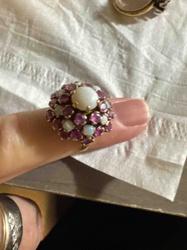
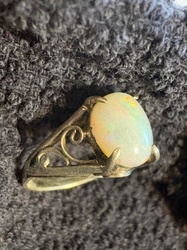
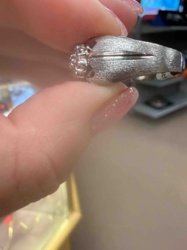
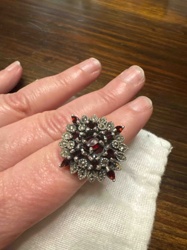
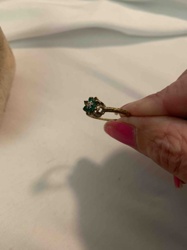
This is a vintage-style cluster cocktail ring featuring an elaborate multi-stone arrangement set in what appears to be yellow gold or gold-plated metal. Centered within the design is a single square-cut teal gemstone, possibly a blue zircon or spinel, oriented in a diamond position. This central stone is surrounded by a complex halo of round-cut gemstones in two distinct colors: deep purplish-red (likely rubies or rhodolite garnets) and dark near-black stones (likely dark garnets or sapphires). The stones are secured using individual prong or bead settings, which create a textured, tiered aesthetic typical of mid-to-late 20th-century jewelry design. The overall silhouette is a modified navette or wide-cluster shape, spanning the width of the finger. Regarding condition, the metal shows signs of moderate oxidation and surface wear, particularly around the prongs, which may indicate a gold-filled or lower-karat gold composition. There are no visible maker's marks or hallmarks from this angle. The arrangement of the stones is asymmetrical in hue, suggesting a handcrafted or mass-produced vintage commercial quality from approximately the 1960s-1980s. The craftsmanship is decent, with stones tightly packed, though some prongs appear slightly uneven upon close inspection.
AI Appraisal Report

·AI can make mistakes·Verify before acting
I have virtually examined this vintage multi-gemstone cluster cocktail ring, which exhibits design characteristics consistent with 1960s-1970s mid-market commercial jewelry. The central square-cut teal gemstone, likely a blue zircon or synthetic spinel, serves as the focal point within a tiered navette-style arrangement of garnets or rubies. The visual oxidation and wear on the prongs suggest a 10K or 14K yellow gold composition, though gold-plating cannot be ruled out without testing. Condition and Authenticity: The piece shows moderate signs of age. The asymmetry in stone hue suggests either original mass-production quality or later replacement of individual stones. Market conditions for 'boho-vintage' jewelry remain stable, though the lack visible hallmarks and the probable lower-karat gold content place this in a more accessible price bracket compared to high-jewelry designer pieces. Market Comparison and Demand: Demand for cocktail rings is currently driven by their aesthetic 'statement' value rather than intrinsic gemological rarity. While visually striking, the stones appear to be commercial-grade with minor surface abrasions. Comparables in the secondary market typically fall within the $400-$700 range for verified gold settings of this era and complexity. Limitation and Verification: This appraisal is based solely on visual inspection. A definitive valuation would require in-person verification of several factors: 1) Metal purity testing via XRF or acid scratch test; 2) Gemological identification using refractometry and polariscopy to distinguish between natural garnets/rubies and synthetic substitutes; and 3) Microscopic inspection of the shank for obscured maker's marks or hallmarks. Provenance documentation could further validate the age and origin of the piece.

Get your items appraised

Instant estimates of your treasures with AI-powered appraisals

Browse More Appraisals