AI estimate as of September 27, 2025 · verify with a professional before acting
AI-Generated · Verify before acting
Everything on this page is generated by AI for informational purposes only. AI can make mistakes — the AI may misidentify items or misattribute them (artist, maker, brand, designer, origin, era). This is not an official valuation and should not be used for insurance, sale, tax, estate, legal, or lending purposes — or any decision requiring a certified appraisal. It is not an authoritative claim about any person, brand, or rights holder — do not share or rely on it as a factual statement about a third party. Always consult qualified professionals before making financial decisions.
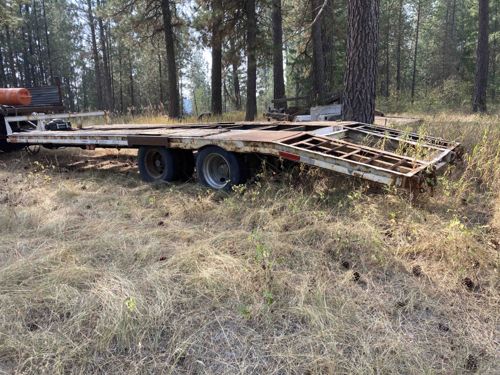
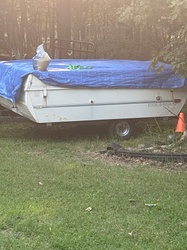
This is a heavy-duty flatbed utility trailer, likely designed for transporting vehicles, heavy equipment, or large loads. The trailer features a robust steel construction, painted a faded white or light off-white color, though much of the original paint has deteriorated, revealing significant rust and exposed metal in various areas. It is equipped with a tandem axle configuration, indicating a substantial weight capacity. Two wheels are visible on the right side, one appearing to use a steel wheel with rust and a flat or deflated tire, and the other a more polished metal wheel (possibly aluminum or chromed steel) also with a flat or significantly deflated tire. The flatbed itself appears to be constructed from a series of parallel steel beams or channels, providing a sturdy, open load-bearing surface. At the rear, there are two distinct, skeletal ramp structures, also made of steel, presumably to facilitate loading and unloading. These ramps show considerable oxidation and are covered in a fine layer of dried vegetation. The trailer is currently situated in an outdoor, overgrown environment, surrounded by dry grass and pine trees, suggesting it has been stored outdoors for an extended period. Visible condition issues include extensive surface rust across almost all metal components, peeling paint, heavily worn or flat tires, and accumulation of dirt and organic debris. There are no obvious manufacturer's marks or distinguishing logos visible in the provided image. The overall appearance suggests a well-used, older model, possibly from the late 20th or early 21st century, in need of significant restoration or repair to be fully operational and roadworthy. Quality indicators point to a functional, work-oriented piece of equipment, built for durability rather than aesthetic appeal, though its current state reflects neglect.
AI Appraisal Report
Based on my visual examination of the Heavy-Duty Flatbed Utility Trailer via the provided image, I assess its current condition as poor, largely due to significant neglect. Authenticity, as a heavy-duty utility trailer, is clear given its robust steel construction, tandem axle, and functional ramp structures. However, I cannot verify manufacturer, model, or year without further examination.
The primary factors impacting its value are the extensive surface rust on virtually all metal components, peeling paint, and the severely worn/flat tires. While the structural integrity of the steel frame appears to be present, these cosmetic and functional issues necessitate considerable restoration effort and cost. The outdoor, overgrown storage environment suggests prolonged exposure to elements, contributing to its deteriorated state.
Market conditions for used utility trailers, even in poor condition, typically show some demand for parts or as restoration projects. Comparables often depend on weight capacity, bed dimensions (not fully ascertainable here), and condition. This trailer, in its current state, would likely be sold 'as-is' for a low price, appealing to buyers with welding skills or those needing heavy steel for other projects. It is not currently roadworthy.
Rarity is not a significant factor here; heavy-duty flatbed trailers are common. However, finding one with such extensive surface rust and non-functional tires can depress value. Without in-person inspection, I cannot assess the extent of rust penetration (pitting, perforations), wheel bearing condition, axle integrity, or the condition of the brake system (if present). A physical examination, including a full mechanical inspection and possibly ultrasonic testing for metal thickness, would be critical for a more precise valuation and to determine the true cost of restoration. Provenance documentation (prior ownership, usage history) would also add historical context but likely not significant monetary value for this type of item.