AI estimate as of July 31, 2025 · verify with a professional before acting
AI-Generated · Verify before acting
Everything on this page is generated by AI for informational purposes only. AI can make mistakes — the AI may misidentify items or misattribute them (artist, maker, brand, designer, origin, era). This is not an official valuation and should not be used for insurance, sale, tax, estate, legal, or lending purposes — or any decision requiring a certified appraisal. It is not an authoritative claim about any person, brand, or rights holder — do not share or rely on it as a factual statement about a third party. Always consult qualified professionals before making financial decisions.
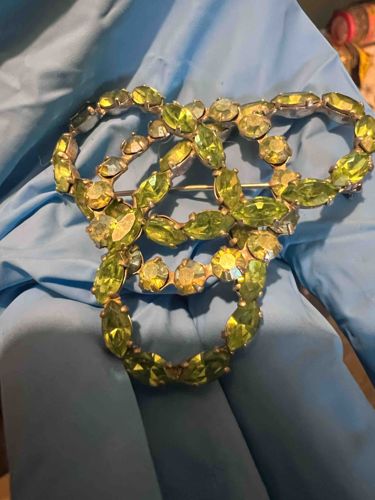
This is a vintage rhinestone brooch, likely from the Mid-20th Century, possibly 1950s-1960s, given its construction and style. The brooch features a complex, intertwined abstract or floral design, formed by three large, rounded components that appear to loop into each other, creating a substantial visual presence. It is heavily adorned with faceted rhinestones in varying shades of green, primarily a vibrant chartreuse or peridot green, and some lighter, almost clear, iridescent stones that show flashes of yellow and blue, possibly indicating an aurora borealis (AB) coating. The rhinestones are set in what appears to be a silver-tone metal, likely a base metal alloy such as pot metal or rhodium-plated base metal, due to the duller sheen and the visible oxidation/patina in some areas. The stones are prong-set, with individual prongs holding each stone securely, a common and durable setting method for costume jewelry. There are both oval/marquise-shaped stones and round-cut stones integrated throughout the design, adding textural variety. The back of the brooch reveals a typical pin mechanism with a hinged pin and a roll-over safety clasp, indicating it is designed to be worn on clothing. Visible condition issues include some wear to the metalwork, showing slight darkening or oxidation consistent with age, and a few rhinestones appear to have lost some of their brilliance or have minor surface abrasions, though none appear to be missing. The overall craftsmanship suggests mass production typical of costume jewelry of the era, focusing on visual impact rather than precious materials. There are no readily discernible maker's marks or signatures visible on the face or reverse of the brooch in the provided image.
AI Appraisal Report
I have examined the image of this Vintage Green Rhinestone Intertwined Brooch. Based on my visual assessment, the brooch appears authentic to its described era, likely Mid-20th Century (1950s-1960s) costume jewelry. The construction, use of diverse green rhinestones (including what appears to be aurora borealis finishes), and silver-tone base metal are consistent with pieces from this period. The design, with its intertwined abstract form and varied stone shapes, is aesthetically pleasing and typical of the era's focus on bold visual impact.
The condition, as far as can be determined from the image, is good vintage condition. There is visible wear to the metalwork, consistent with age and typical for base metal, showing some darkening or oxidation. A few rhinestones exhibit minor surface wear or dullness, but crucially, no stones appear to be missing. The pin mechanism seems intact.
In terms of market conditions, vintage costume jewelry, especially pieces with vibrant colors and intricate designs like this one, continues to have a steady demand among collectors and enthusiasts. While not rare, well-preserved examples are desirable. Comparables for unsigned costume brooches of this quality generally fall within a specific price range. Factors impacting value positively include the intricate design, the substantial size, the good condition (no missing stones), and the appealing green color palette. The primary limitation to value is the lack of a discernible maker's mark, which prevents attribution to a more sought-after designer and restricts it to a general costume jewelry valuation.
My appraisal is limited by the visual information provided. For full authentication and a more precise condition assessment, a physical examination would be crucial to inspect the metal for true composition, confirm stone settings, and identify any hidden damage or repairs. Provenance documentation, if available, could also enhance value by linking the piece to a specific collection or history. Scientific testing, such as spectroscopy, could definitively confirm stone treatments or metal composition if there were any doubts about authenticity.