AI estimate as of November 19, 2025 · verify with a professional before acting
AI-Generated · Verify before acting
Everything on this page is generated by AI for informational purposes only. AI can make mistakes — the AI may misidentify items or misattribute them (artist, maker, brand, designer, origin, era). This is not an official valuation and should not be used for insurance, sale, tax, estate, legal, or lending purposes — or any decision requiring a certified appraisal. It is not an authoritative claim about any person, brand, or rights holder — do not share or rely on it as a factual statement about a third party. Always consult qualified professionals before making financial decisions.
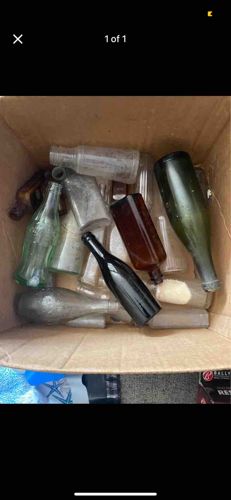
This item consists of a collection of assorted antique and vintage glass bottles, presented together in a cardboard box. The collection includes bottles of various sizes, shapes, and glass colors, indicative of different manufacturers, intended uses, and manufacturing periods. Observable glass colors include clear, light green (one notably a Coca-Cola hobbleskirt bottle), dark green, amber/brown, and a distinct black/dark olive bottle. Many of the clear and lighter-colored bottles display a significant degree of opalescence or 'sickness,' a cloudy white or iridescent film on the interior and/or exterior, typically resulting from age, burial, or prolonged exposure to moisture and minerals in the soil. Several bottles appear to be crown-top or blob-top styles, common for beverages. Some possess embossed details, though specific markings are not clearly discernible in the provided image. The construction varies from clearly machine-made examples to possibly earlier, more crudely formed bottles that might indicate mouth-blown origins, particularly those with less uniform glass thickness or visible seams. The condition of the bottles is varied, with some showing extensive surface wear, grime, and the aforementioned glass sickness. No obvious breaks or large chips are visible, but the overall patina suggests they have been recovered from an outdoor environment or stored for a significant period. The collection represents a span of historical periods, likely ranging from the late 19th century through the mid-20th century, offering a historical cross-section of common everyday glass containers. The quality of craftsmanship also varies, from utilitarian mass-produced bottles to potentially more specialized or early examples that required more skilled production techniques.
AI Appraisal Report
Based on my visual examination of the provided image, this mixed assortment of antique and vintage glass bottles presents a common collection. The authenticity of these bottles as historical items is generally good, given the variety of styles, colors (clear, light green, dark green, amber/brown, black/dark olive), and manufacturing characteristics evident, such as varying glass thickness and what appears to be both machine-made and potentially mouth-blown examples. The visible 'sickness' or opalescence on many bottles confirms their age and probable recovery from burial or prolonged exposure, adding to their authentic patina rather than detracting significantly, as it's a common characteristic of aged glass.
However, the condition is fair to good overall, with prevalent surface wear and grime. While no obvious breaks or large chips are visible in the image, the 'sickness' can significantly obscure embossed details, which are often key to identifying specific manufacturers, dates, and increasing individual bottle value. There is a notable Coca-Cola hobbleskirt bottle, which, if in better condition, could hold more value individually but here is part of a mixed lot.
Market conditions for such mixed assortments are generally moderate. Unless there are particularly rare or desirable bottles hidden within the collection (e.g., highly sought-after poisons, inks with unique forms, or named early sodas in pristine condition), the value is limited. Demand is primarily from casual collectors, crafters, or for decorative purposes. Rarity cannot be assessed without clear identification of each bottle; most common utility bottles from the late 19th to mid-20th century are not rare.
Factors impacting value significantly are the lack of clear, identifiable embossing, the mixed condition (especially the 'sickness'), and the fact that it's an uncurated lot rather than individual, high-grade examples. Many appear to be common beverage bottles.
My assessment of authenticity is based purely on visual cues from the image. For full authentication, particularly for determining manufacturing methods (mouth-blown vs. machine-made) and specific dates, an in-person examination would be crucial. This would allow for tactile inspection of seams, pontil marks (if any), and full clarity on embossed details. Cleaning some bottles might reveal significant markings. Provenance documentation, while unlikely for such common items, would confirm history. Scientific testing is generally not required for such a collection unless a specific, high-value bottle was suspected of being a reproduction.