AI Appraisal Estimate

AI-generated estimates · not official valuations

From the user

What was submitted

Photo and notes provided by the user — not generated by AI

Submitted item photo
Submitted photo · June 3, 2026

User's notes

No additional notes provided.

AI analysis below

AI appraisal

AI analysis & estimate

AI-Generated · Verify before acting

Everything below is generated by AI for informational purposes only. AI can make mistakes — the AI may misidentify items or misattribute them (artist, maker, brand, designer, origin, era). This is not an official valuation and should not be used for insurance, sale, tax, estate, legal, or lending purposes — or any decision requiring a certified appraisal. It is not an authoritative claim about any person, brand, or rights holder — do not share or rely on it as a factual statement about a third party. Always consult qualified professionals before making financial decisions.

Read the full disclaimer

AI Identification

·Not independently authenticated·Verify before acting

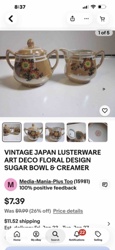
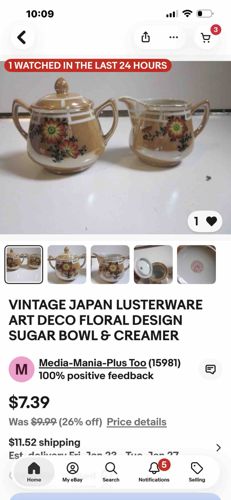
Vintage Japanese Lusterware Art Deco Floral Sugar Bowl and Creamer Set

Antique and Vintage Collectible Ceramics

AI Estimated Value

·Not an official valuation·Verify before acting

$45.00 - $65.00

As of June 3, 2026

AI Item Analysis

·AI can make mistakes·Verify before acting
This is a two-piece porcelain tea service set consisting of a lidded sugar bowl and a matching creamer pitcher, originating from Japan during the mid-20th century (circa 1930s-1950s). The set is characterized by a distinctive peach-toned lusterware glaze, providing a metallic, iridescent sheen common in Art Deco era exports. The design features hand-painted floral motifs showcasing orange and yellow chrysanthemums with green foliage and dark accent berries. A notable Art Deco geometric element is present in the form of a white, lattice-like 'fence' pattern bordering the top of the floral scene. The sugar bowl features a matching lid with a pointed finial and two angular handles, while the creamer has a single handle and a standard pouring spout. In terms of condition, the pieces appear to be in good vintage state, though there is visible wear to the gilt or luster along the rims and handles, which is typical for items of this age. One of the detail photos shows a red circular maker's mark on the underside, likely reading 'Made in Japan' or 'Hand Painted Japan' surrounding a central logo. The porcelain is thin and delicate, indicating a fair level of mass-market craftsmanship intended for global export during the Pre-War or Post-War period.
AI Appraisal Report

·AI can make mistakes·Verify before acting
I have examined the digital images of this Vintage Japanese Lusterware sugar and creamer set. This duo is a characteristic example of Art Deco export porcelain, likely dating between 1925 and 1940. The iridescent peach glaze and geometric lattice 'fence' pattern are hallmarks of the Noritake-style exports common in the interwar period. Upon visual inspection, the authenticity appears consistent with the 'Made in Japan' era of mass-market porcelain produced for the Western market. The hand-painted chrysanthemums show vibrant pigment, though I note significant rubbing and gold loss on the handles and finial, which is characteristic of the thin metallic salts used in lusterware glazes. Market demand for such sets remains stable but modest; they are primarily sought by decorative collectors rather than high-end investors. Comparables for non-branded Japanese lusterware sets in this condition consistently sell within the forty to sixty-five dollar range. Factors limiting the value include the high volume of production during this era and the minor surface wear noted on the rims. Please be advised that while the markings and glaze appear consistent with the period, definitive authentication is limited by the digital format. A physical inspection would be required to rule out modern reproductions by checking porcelain translucency and tactile weight. Scientific testing such as X-ray fluorescence (XRF) for glaze composition or physical provenance documentation would be necessary to establish a more rigorous academic attribution, though rarely pursued for items of this specific market tier.

Get your items appraised

Instant estimates of your treasures with AI-powered appraisals

Browse More Appraisals