AI estimate as of November 18, 2025 · verify with a professional before acting
AI-Generated · Verify before acting
Everything on this page is generated by AI for informational purposes only. AI can make mistakes — the AI may misidentify items or misattribute them (artist, maker, brand, designer, origin, era). This is not an official valuation and should not be used for insurance, sale, tax, estate, legal, or lending purposes — or any decision requiring a certified appraisal. It is not an authoritative claim about any person, brand, or rights holder — do not share or rely on it as a factual statement about a third party. Always consult qualified professionals before making financial decisions.
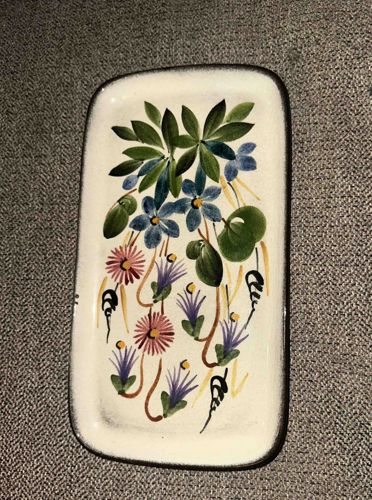
This is a hand-painted ceramic rectangular dish, likely intended for serving or decorative purposes, adorned with a vibrant floral motif. The dish features a creamy off-white or light ivory glazed background, providing a neutral canvas for the colorful illustration. The edges of the dish are subtly rounded and have a dark brown or black rim, which offers a striking contrast to the lighter body and helps define its shape. The central design is a lively arrangement of various stylized flowers and foliage. Notable elements include clusters of broad green leaves, possibly indicative of herbaceous plants, along with blue five-petaled flowers, pink or mauve daisy-like blossoms with yellow centers, and purple spiky florets. Thin, curvilinear brown stalks and tendrils connect these elements, adding to the organic flow of the design. Black accent lines, possibly representing details or stylized tendrils, are interspersed throughout the composition, particularly visible in the lower half of the design. The painting style appears folk art inspired, characterized by its somewhat naive yet charming execution and bold color application. The glaze appears consistent, exhibiting a slight sheen, although minor irregularities or brushstroke marks, characteristic of handmade items, might be present upon closer inspection. No visible chips, cracks, or significant wear are evident from the provided image, suggesting good to excellent condition. The item's construction points towards a ceramic material, possibly earthenware or stoneware, glazed for durability and aesthetic appeal. Given the artistic style, it could date from the mid to late 20th century, potentially originating from a region known for artisanal pottery.
AI Appraisal Report
Based on my visual examination of the provided image, this hand-painted ceramic rectangular dish appears to be in very good to excellent condition. I observe no chips, cracks, or significant wear, and the glaze appears consistent with a pleasant sheen. The authenticity as a hand-painted ceramic item is clear from the visual brushstrokes and folk art style, which often features a charming, somewhat naive execution. Without a physical inspection, however, I cannot definitively verify the exact ceramic type (e.g., earthenware, stoneware) or confirm the absence of any minor firing imperfections or subsurface issues that might affect durability or long-term value.
Market conditions for decorative ceramic dishes of this type are generally stable. Comparables would include similar hand-painted, artisan-made serving or decorative dishes from the mid to late 20th century. Values for such items are largely driven by aesthetic appeal, condition, and, if readily identifiable, the artist or pottery studio. The vibrant floral motif is appealing and could align with a range of interior design styles, contributing to a moderate level of demand among collectors of decorative arts and functional ceramics. Rarity is difficult to ascertain from an image alone; while likely not mass-produced, such pieces were often made in limited quantities by independent artisans.
Factors significantly impacting value include the excellent apparent condition and the attractive, colorful design. Were a specific artist's signature or pottery mark identifiable, or if the piece could be attributed to a recognized pottery region or movement, its value could increase significantly. Conversely, if it were found to be a modern reproduction or if hidden flaws were discovered upon physical inspection, the value would decrease. For full authentication and to ascertain provenance, an in-person examination would be crucial to check for maker's marks, assess the ceramic body, and conduct any necessary scientific testing if origin specifics were in question.