AI estimate as of July 13, 2025 · verify with a professional before acting
AI-Generated · Verify before acting
Everything on this page is generated by AI for informational purposes only. AI can make mistakes — the AI may misidentify items or misattribute them (artist, maker, brand, designer, origin, era). This is not an official valuation and should not be used for insurance, sale, tax, estate, legal, or lending purposes — or any decision requiring a certified appraisal. It is not an authoritative claim about any person, brand, or rights holder — do not share or rely on it as a factual statement about a third party. Always consult qualified professionals before making financial decisions.
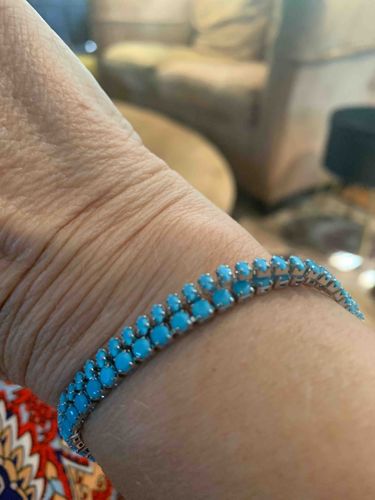
This item is a turquoise tennis bracelet, featuring two parallel rows of uniformly sized, cabochon-cut turquoise stones. Each individual stone is set in what appears to be a bezel or prong setting, likely made of a silver-toned metal, possibly sterling silver or white gold, given its sheen and color. The vibrant robin's egg blue color of the turquoise is consistent across all visible stones, suggesting either natural turquoise of similar origin or well-matched treated/simulated stones. The construction of the bracelet implies a flexible, linked design, characteristic of a tennis bracelet, allowing it to conform to the wrist. The visible portion shows good craftsmanship with secure settings. There are no obvious signs of significant wear, damage, or missing stones from the angle provided. The metal appears clean with minimal tarnish or patina, indicating good maintenance or recent cleaning. The bracelet's design is classic and timeless, which could place its style period from the mid-20th century onwards, or a contemporary piece designed with a vintage aesthetic. No specific maker's marks or signatures are discernible from the image. The quality of the stone matching and setting indicates a well-made piece of costume or fine jewelry.
AI Appraisal Report
Based on my visual examination of the provided image, I appraise this double-row turquoise tennis bracelet. The condition appears to be very good; I see no obvious signs of significant wear, damage, or missing stones. The consistent vibrancy of the robin's egg blue turquoise and the neatness of the settings suggest a well-made piece. The metal, likely a silver-toned alloy, appears clean.
Authenticity of the turquoise is the primary limitation. From an image alone, it's impossible to definitively determine if these are natural, stabilized, treated, or simulated turquoise stones. The uniformity could suggest stabilization or treatment for color consistency. Similarly, the metal could be sterling silver, white gold, or a base metal alloy, which significantly impacts value. Without hallmarks, material testing, or a jeweler's loupe, these remain assumptions. Market conditions for turquoise jewelry are generally stable, with natural, untreated turquoise commanding higher prices. The 'tennis bracelet' style ensures broad consumer appeal. However, this is a common design, so rarity is low.
Factors significantly impacting value include the authenticity and quality of the turquoise (natural vs. treated/simulated), the metal type (precious vs. base), and the total carat weight of the stones. For a full authentication, I would require a physical inspection to test the metal for purity, assess the turquoise's authenticity through gemological instruments (e.g., spectrometer, refractive index), and check for maker's marks. Provenance documentation would also be highly beneficial to establish the history and origin. Given these limitations, this appraisal assumes it is a well-made piece, likely sterling silver with stabilized or treated turquoise.