AI estimate as of August 19, 2025 · verify with a professional before acting
AI-Generated · Verify before acting
Everything on this page is generated by AI for informational purposes only. AI can make mistakes — the AI may misidentify items or misattribute them (artist, maker, brand, designer, origin, era). This is not an official valuation and should not be used for insurance, sale, tax, estate, legal, or lending purposes — or any decision requiring a certified appraisal. It is not an authoritative claim about any person, brand, or rights holder — do not share or rely on it as a factual statement about a third party. Always consult qualified professionals before making financial decisions.
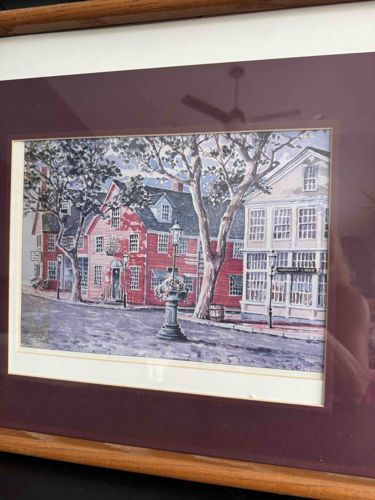
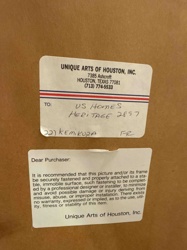
This item is a framed watercolor print depicting a charming street scene, likely of an old European or colonial American town. The print features several multi-story buildings, prominently a red-shingled structure on the left and a lighter, possibly cream or pale yellow, building with large storefront windows on the right. Both buildings exhibit numerous windows with multi-pane sashes, suggesting an older architectural style. Interspersed between the buildings are mature trees with visible trunks and branches, although the foliage appears somewhat sparse, possibly indicating a late fall or early spring setting. A decorative street lamp or water fountain with floral arrangements at its top stands in the foreground, centrally located. The street itself appears to be paved with cobblestones or similar rustic material, rendered in shades of grey and purple, suggesting dampness or deep shadow. The colors in the print are muted yet vibrant, typical of watercolor, with blues, reds, greens, and browns dominating. The artwork is housed within a multi-layered frame. The innermost layer is a white mat, followed by a wider, dark plum or burgundy colored mat, and finally enclosed by an outer frame constructed of what appears to be natural wood, possibly oak, with a reddish-brown stain and visible grain. The frame shows some minor wear consistent with handling, particularly on the outer wooden edge, but no significant damage or repairs are immediately visible. The print itself appears to be in good condition, protected by glass or acrylic, with no obvious signs of fading, creasing, or foxing. The reflection of a ceiling fan in the top right suggests the presence of a transparent protective layer. No artist's signature, title, or edition number is clearly visible in the provided images, making it difficult to discern manufacturing details or a precise age, but the style seems to align with mid to late 20th-century decorative art.
AI Appraisal Report
Upon my virtual examination of this framed watercolor print depicting an 'Old Town Street Scene,' I assess its condition as good. The print itself shows no visible signs of fading, creasing, or foxing, appearing well-preserved behind its protective layer. The frame exhibits minor wear consistent with handling, particularly on the outer wooden edge, but no significant damage. Authenticity based solely on visual inspection via images is limited; I cannot verify if this is an original watercolor or a reproduction without direct physical examination. The reflection of a ceiling fan confirms a protective glazing is present.
Analyzing market conditions, decorative watercolor prints of generic street scenes, particularly unsigned ones, typically fall into a modest value range. Comparables in the secondary market, such as online marketplaces or local antique shops, suggest a strong supply for this type of decorative art. Demand is generally from individuals seeking aesthetically pleasing wall decor rather than investment pieces. Rarity is low; similar prints were widely produced in the mid to late 20th century. Factors impacting value include the lack of an identifiable artist, title, or edition number, which significantly reduces its collectibility beyond its decorative appeal. The pleasant composition and good condition offer some intrinsic value.
For full authentication and to ascertain if this is an original artwork or a print, in-person examination would be crucial. This would involve inspecting the paper quality, analyzing brushstrokes (if any are present), and examining edges for plate marks or printing indicators. Provenance documentation, such as purchase receipts or artist information, would also be invaluable. Scientific testing, like pigment analysis, would be necessary for a definitive determination of age and medium if there was any doubt following a physical inspection.