AI estimate as of December 13, 2025 · verify with a professional before acting
AI-Generated · Verify before acting
Everything on this page is generated by AI for informational purposes only. AI can make mistakes — the AI may misidentify items or misattribute them (artist, maker, brand, designer, origin, era). This is not an official valuation and should not be used for insurance, sale, tax, estate, legal, or lending purposes — or any decision requiring a certified appraisal. It is not an authoritative claim about any person, brand, or rights holder — do not share or rely on it as a factual statement about a third party. Always consult qualified professionals before making financial decisions.
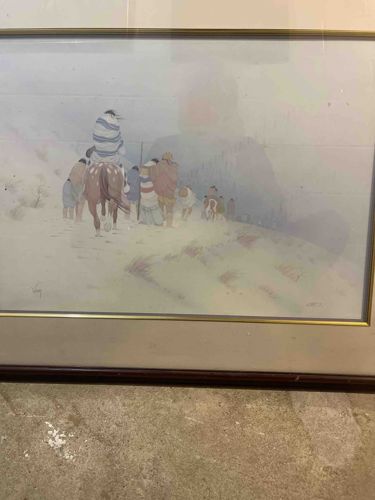
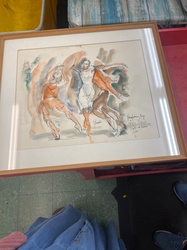
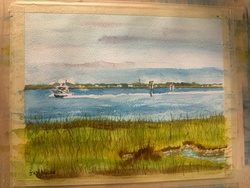
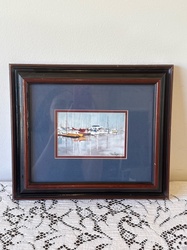
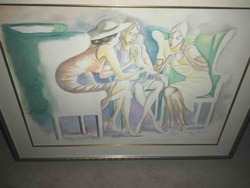
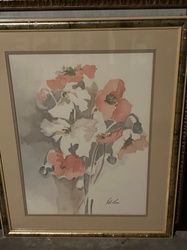
This item is a framed watercolor painting depicting a group of indigenous figures, some on horseback, traversing a snowy or dusty landscape. The central figure is mounted on a brown horse, viewed from behind, wrapped in a striped blanket of blue and white. Several other figures in traditional clothing, predominantly in earthy tones like red-brown and beige, are walking alongside or ahead. The background is a soft, muted wash of pale blues and grays, suggesting a vast, possibly cold or hazy environment. The watercolor medium gives the painting a delicate and somewhat ethereal quality, with soft edges and blended colors. The overall palette is subdued, focusing on natural hues. There are no discernible maker's marks or signatures visible in the provided image. The painting is housed under glass within a matted frame. The frame itself appears to be a two-tone design, featuring a thin inner gold-colored metal or gilded strip closest to the artwork, followed by a wider middle matting section (color appears light beige or off-white), and an outer dark brown wooden frame. The visible condition of the painting itself appears generally good, though there are reflections on the glass suggesting it has not been removed from its frame. The frame shows some slight wear, particularly the darker outer section, though it is not significant damage. The composition suggests a narrative or genre scene, possibly depicting a journey or migration. The style points towards a 20th-century artistic hand, possibly mid to late 20th century, given the soft watercolor technique and thematic content.
AI Appraisal Report
Based on my visual examination of the provided image, this framed watercolor painting depicts indigenous figures on horseback, traversing what appears to be a snowy or dusty landscape. The condition of the painting itself appears good through the glass, with no obvious damage, fading, or foxing visible. The frame shows minor wear, consistent with its age, but nothing that significantly detracts from its display value. The artistic style, soft edges, and blended colors are characteristic of watercolor techniques, suggesting a 20th-century hand. The thematic content, depicting what may be a journey or migration, aligns with genre scenes popular in this period.
Authenticity is difficult to ascertain from an image alone, especially without a visible signature or artist's mark. The lack of a discernible signature limits the ability to attribute the work to a known artist, which significantly impacts its value. Market conditions for unsigned 20th-century watercolor landscapes or genre scenes, particularly those without a strong artistic provenance, generally place them in a modest value bracket. Demand for such pieces is moderate, appealing primarily to collectors of Western art or those seeking decorative pieces. Rarity is not a significant factor here without artist identification.
Significant factors impacting value include the absence of a signature, the unknown artist, and the decorative rather than fine-art classification due to these unknowns. For full authentication and a more precise valuation, an in-person examination would be crucial to inspect the paper, pigments, and technique more closely, search for hidden marks, and assess the overall condition outside the frame. Provenance documentation, if available, would be invaluable.