AI estimate as of August 6, 2025 · verify with a professional before acting
AI-Generated · Verify before acting
Everything on this page is generated by AI for informational purposes only. AI can make mistakes — the AI may misidentify items or misattribute them (artist, maker, brand, designer, origin, era). This is not an official valuation and should not be used for insurance, sale, tax, estate, legal, or lending purposes — or any decision requiring a certified appraisal. It is not an authoritative claim about any person, brand, or rights holder — do not share or rely on it as a factual statement about a third party. Always consult qualified professionals before making financial decisions.
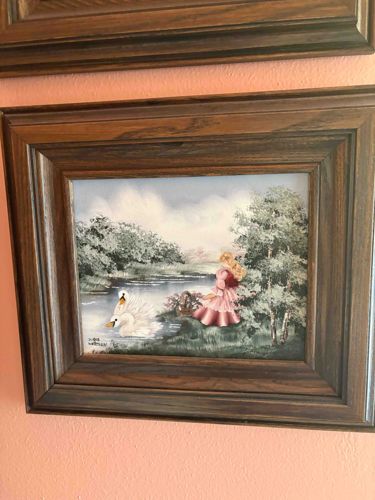
This item is a framed illustrative artwork, likely executed in watercolor or gouache, depicting a pastoral scene. The central focus is a blonde-haired figure, possibly a young girl or woman, in a voluminous pink dress with ruffles, seated by a serene body of water. Adjacent to her in the water are two white swans, one prominently in the foreground with its head visible. The background features lush green trees and a calm, possibly overcast, sky. The artistic style appears to be illustrative with a somewhat whimsical or romantic feel, typical of decorative art from the mid to late 20th century. The colors are soft and muted, with emphasis on the pink of the dress and the white of the swans, contrasting with the greens and blues of the landscape. The artwork itself shows no apparent damage or significant wear, maintaining its color vibrancy. It is housed within a sturdy wooden frame with a medium to dark brown stain, exhibiting a visible wood grain. The frame features a classic profile with stepped or beveled edges, adding depth and a traditional aesthetic. There is a visible artist's signature in the bottom left corner, which appears to read 'Judith W. Newman'. The overall condition of the frame seems good, with minor signs of handling such as slight scuffs consistent with age and typical display, but no major cracks or chips. Given the style and materials, it likely dates from the 1970s to 1990s.
AI Appraisal Report
Upon visual examination of the provided image, this pastoral scene artwork, likely watercolor or gouache, appears to be in very good condition. The colors remain vibrant, and there are no visible signs of damage to the artwork itself. The frame, a sturdy wooden piece with a medium-to-dark stain and classic profile, also appears well-preserved with only minor scuffs consistent with age, indicating good care.
The artist's signature, "Judith W. Newman," is visible in the bottom left. While I can authenticate the presence and legibility of the signature itself from the image, full authenticity of the artwork as an original work by Judith W. Newman would require in-person examination to verify media and technique, cross-referencing with known works, and ideally, provenance documentation. Scientific testing of pigments or paper is not necessary given the visual representation for an initial appraisal. Without these, it is not possible to definitively authenticate this piece solely on the basis of a digital image.
Market conditions for illustrative works of this style from the late 20th century are generally stable, driven by aesthetic appeal as decorative art rather than significant artistic movements. Comparables from similar artists working in this genre show modest values unless the artist has a significant exhibition history or strong collector following. Demand is primarily from those seeking charming, decorative pieces for home use. Rarity is not a major factor as artists like Judith W. Newman often produced numerous works. The primary value drivers for this piece are its aesthetic appeal, good condition, and the tasteful framing.
The main limitation in verifying authenticity is the lack of physical inspection, which prevents me from confirming the specific medium (watercolor vs. gouache), the quality of the paper, or detecting any subtle restorations not visible in a photograph. Provenance, if available, documenting the artwork's history of ownership, would also significantly aid in authentication and potentially value.