AI Appraisal Estimate

AI-generated estimates · not official valuations

From the user

What was submitted

Photo and notes provided by the user — not generated by AI

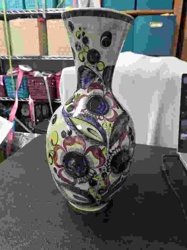
Submitted item photo
Submitted photo · May 18, 2026

User's notes

No additional notes provided.

AI analysis below

AI appraisal

AI analysis & estimate

AI-Generated · Verify before acting

Everything below is generated by AI for informational purposes only. AI can make mistakes — the AI may misidentify items or misattribute them (artist, maker, brand, designer, origin, era). This is not an official valuation and should not be used for insurance, sale, tax, estate, legal, or lending purposes — or any decision requiring a certified appraisal. It is not an authoritative claim about any person, brand, or rights holder — do not share or rely on it as a factual statement about a third party. Always consult qualified professionals before making financial decisions.

Read the full disclaimer

AI Identification

·Not independently authenticated·Verify before acting

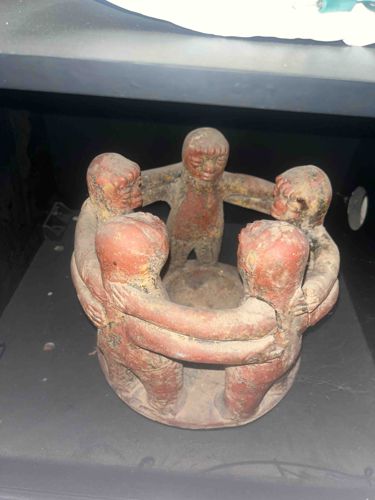
Traditional Circle of Friends Candle Holder

Folk Art / Pottery

AI Estimated Value

·Not an official valuation·Verify before acting

$15-25

As of May 18, 2026

AI Item Analysis

·AI can make mistakes·Verify before acting
This is a hand-crafted 'Circle of Friends' decorative sculpture, commonly utilized as a candle holder. The piece is constructed from earthenware terracotta clay, featuring five stylized human figures linked together by their arms in a continuous circular embrace around a central bowl or well. The figures exhibit folk-art characteristics including simple facial features, round heads, and chunky torsos. The surface is finished with a rustic reddish-orange slip or wash that has been deliberately weathered or aged. Notable physical characteristics include the integrated circular base and the way the arms are fused to the neighboring figures' shoulders, creating a structural ring. The condition appears well-used with a significant amount of surface patina, dust accumulation, and visible white mineral deposits or 'efflorescence' typical of unglazed clay exposed to moisture. There are areas of visible wear where the red pigment has rubbed away to reveal the lighter tan clay beneath, particularly on the heads and arms. While the style mimics ancient Pre-Columbian artifacts, this is a modern folk-art creation, likely from the late 20th century. The quality is indicative of standard souvenir-grade pottery, characterized by its heavy, thick-walled construction and irregular, hand-molded textures rather than fine porcelain refinement.
AI Appraisal Report

·AI can make mistakes·Verify before acting
I have conducted a visual examination of this earthenware 'Circle of Friends' candle holder. This piece is a classic example of modern Mexican folk-art pottery, commonly produced in the Tonala or Jalisco regions in the late 20th century. My examination of the slip application and hand-molded earthenware confirms this is a souvenir-grade decorative item rather than an antique or Pre-Columbian artifact. The condition is fair to good. I observe significant efflorescence—white mineral deposits—which suggests the piece was likely used outdoors or in high-humidity environments. The surface wear on the heads and shoulders is consistent with handling and a weathered aesthetic. Markets for these items are currently oversaturated; they were mass-produced for the export and tourism industries between 1980 and 2000. They are frequently found at estate sales and secondary markets, which keeps the rarity factor very low. Key value constraints include the lack of a maker's mark or signature and the presence of heavy surface dust and mineral buildup. Similar five-figure terracotta models typically realize between $15 and $25 at retail. Limitations regarding this appraisal: This assessment is based solely on digital imagery. To provide a definitive authentication of the clay's age, a physical inspection is required to check for structural cracks hidden by the mineral deposits. Furthermore, checking for a stamped 'Hecho en Mexico' mark on the base would confirm its origin. Scientific testing, such as thermoluminescence, would be necessary to rule out ancient origins, though the stylistic markers strongly indicate modern production.

Get your items appraised

Instant estimates of your treasures with AI-powered appraisals

Browse More Appraisals