These notes were written by the person who submitted this item. Appraiser.AI has not verified them, and the AI's identification and estimate may rely on them.
AI Estimated Value
Not an official valuation
$50-150
AI estimate as of September 16, 2025 · verify with a professional before acting
AI-Generated · Verify before acting
Everything on this page is generated by AI for informational purposes only. AI can make mistakes — the AI may misidentify items or misattribute them (artist, maker, brand, designer, origin, era). This is not an official valuation and should not be used for insurance, sale, tax, estate, legal, or lending purposes — or any decision requiring a certified appraisal. It is not an authoritative claim about any person, brand, or rights holder — do not share or rely on it as a factual statement about a third party. Always consult qualified professionals before making financial decisions.
This analysis also relies on unverified notes provided by the user, which may be incomplete or inaccurate and could affect the result.
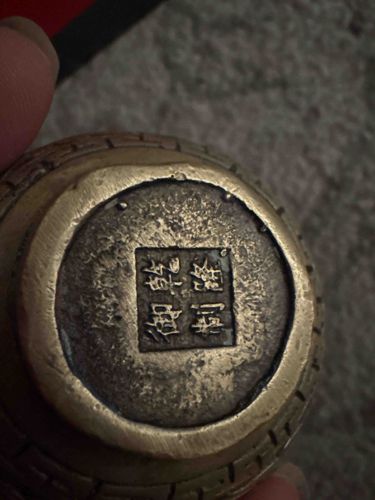
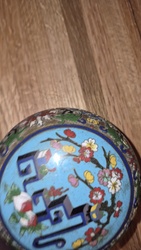
This image primarily shows the bottom section of what appears to be a small, possibly decorative, object. The material is a tarnished brass or bronze alloy, displaying a rich, uneven patina with shades of gold, brown, and dark gray, indicative of age and handling. The central feature is a recessed circular area, within which a square-shaped inscription in traditional Chinese calligraphy is prominently displayed. The characters, from what is discernible, suggest a maker's mark or perhaps an auspicious phrase. The surrounding circular rim is raised and shows subtle concentric tooling marks, implying it was turned or cast. The outer edge of the object, partially visible, has a ridged or segmented pattern, suggesting the craftsmanship of the full item. This pattern could be wood grain, carving, or a textured metal design that continues around the body of the object. There are no obvious signs of significant damage such as cracks or major dents, but the surface exhibits a natural wear and oxidation consistent with an antique or vintage piece. The craftsmanship appears to be of good quality, with clear, albeit aged, inscription details. Given the context (Hulu gourd shaped with yin yang), this bottom piece is likely from a Chinese brass or bronze hulu, a traditional decorative and symbolic item. The calligraphy could provide key information regarding its origin, maker, or period, potentially linking it to the Qing dynasty or later, depending on the specific characters and style. The overall feel is one of an item that has been cherished and used, with the patina contributing to its aesthetic appeal and historical character.
AI Appraisal Report
Upon examination of the image of this item, which appears to be the brass or bronze base of a Chinese hulu (gourd), I can offer a preliminary assessment. The piece presents with a rich, uneven patina that suggests some age, although it could also be artificially induced. The central feature is a recessed square mark with Chinese characters, likely a maker's or reign mark. The overall form suggests it's part of a decorative object, possibly an incense holder or a container for small items, often associated with Daoist symbolism, especially given the owner's mention of a yin-yang motif on the full gourd.
Based on the visual information alone, the condition appears fair, showing wear and oxidation consistent with handling. However, the exact age and origin are difficult to determine. The mark, while present, needs expert translation and comparison to known examples to ascertain if it is a genuine period mark (e.g., from the Qing Dynasty) or a later, apocryphal mark, which is very common on 20th-century reproductions. The market for such items is saturated with modern and vintage replicas. Without clear provenance or a discernible, high-quality period mark, this piece is likely a 20th-century decorative item. Comparable decorative brass hulus from the mid to late 20th century typically trade for modest sums at auction and online marketplaces.
To establish authenticity and a higher value, an in-person examination is essential to assess the weight, casting quality, and tooling marks. Furthermore, a specialist in Chinese characters would need to translate the mark, and metallurgical testing could help date the alloy. Lacking this verification, the item must be appraised as a decorative piece of uncertain age. My valuation reflects its decorative appeal rather than any confirmed antique status.