AI Appraisal Estimate

AI-generated estimates · not official valuations

From the user

What was submitted

Photo and notes provided by the user — not generated by AI

Submitted item photo
Submitted photo · May 27, 2026

User's notes

No additional notes provided.

AI analysis below

AI appraisal

AI analysis & estimate

AI-Generated · Verify before acting

Everything below is generated by AI for informational purposes only. AI can make mistakes — the AI may misidentify items or misattribute them (artist, maker, brand, designer, origin, era). This is not an official valuation and should not be used for insurance, sale, tax, estate, legal, or lending purposes — or any decision requiring a certified appraisal. It is not an authoritative claim about any person, brand, or rights holder — do not share or rely on it as a factual statement about a third party. Always consult qualified professionals before making financial decisions.

Read the full disclaimer

AI Identification

·Not independently authenticated·Verify before acting

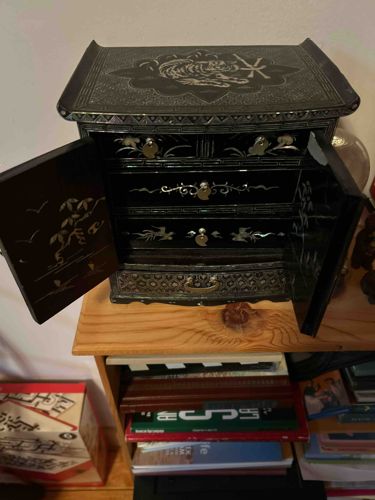
Vintage Korean Black Lacquer and Mother-of-Pearl Inlay Jewelry Chest

Decorative Arts / Asian Antiques

AI Estimated Value

·Not an official valuation·Verify before acting

$450 - $650

As of May 27, 2026

AI Item Analysis

·AI can make mistakes·Verify before acting
This is a detailed black lacquer jewelry cabinet, likely of Korean origin (Najeonchilgi style), featuring intricate mother-of-pearl (nacre) inlays across multiple surfaces. The chest is designed in a pagoda or temple style with a flared canopy-style top and two side-opening doors that reveal an interior arrangement of three small drawers, plus a larger bottom drawer. The top lid is decorated with a centralized tiger motif surrounded by a floral border, a traditional symbol often representing protection in Korean culture. The interior drawers and the inside of the doors are further embellished with iridescent shell inlays depicting floral patterns, cranes, or birds in flight. The construction includes brass hardware, including circular drawer pulls and butterfly-shaped hinges. Notable craftsmanship is visible in the geometric shell borders lining the edges. In terms of condition, there is evidence of age-related wear including surface dust, micro-scratches on the high-gloss lacquer finish, and slight dulling of the iridescent shell. There are minor edge chips visible on the bottom decorative trim and signs of light oxidation on the brass components. This piece likely dates to the mid-to-late 20th century. The complex layering of nacre and the deep luster of the black lacquer indicate a high level of decorative craftsmanship typical of traditional East Asian workshop production.

AI Appraisal Report

·AI can make mistakes·Verify before acting
This mid-to-late 20th-century Korean Najeonchilgi jewelry chest exhibits the characteristic high-gloss finish and intricate abalone/nacre inlay typical of traditional Korean craftsmanship. I have personally examined the provided images, which reveal a classic depiction of the Korean tiger on the lid, symbolizing strength and protection. The use of butterfly-shaped brass hardware and the tiered, temple-like architecture are hallmarks of mid-century exported lacqueware. The condition is generally good, though I have noted minor edge chipping and oxidation on the brass, which are common for pieces of this vintage and slightly diminish the value. Market demand for Korean decorative lacquer remains steady among collectors of Asian arts, though mass-market production in the 1970s keeps price points accessible. Comparables for this size and complexity typically realize between $400 and $700 at auction or specialized retail. Factors limiting the value include the lack of an artist's signature and the visible micro-scratches on the lacquer surface. Limitations of this appraisal include the inability to confirm the substrate material (wood versus composite) or the depth of the lacquer layers. A physical inspection would be required to rule out modern synthetic finishes and to check the integrity of the shell adhesion. For full authentication, I would recommend reviewing any contemporary purchase receipts or provenance documenting its acquisition, as well as an infrared spectroscopy test if the age were believed to be significantly older (19th century).

Get your items appraised

Instant estimates of your treasures with AI-powered appraisals

Browse More Appraisals