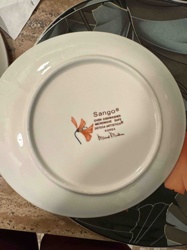
AI estimate as of August 22, 2025 · verify with a professional before acting
AI-Generated · Verify before acting
Everything on this page is generated by AI for informational purposes only. AI can make mistakes — the AI may misidentify items or misattribute them (artist, maker, brand, designer, origin, era). This is not an official valuation and should not be used for insurance, sale, tax, estate, legal, or lending purposes — or any decision requiring a certified appraisal. It is not an authoritative claim about any person, brand, or rights holder — do not share or rely on it as a factual statement about a third party. Always consult qualified professionals before making financial decisions.
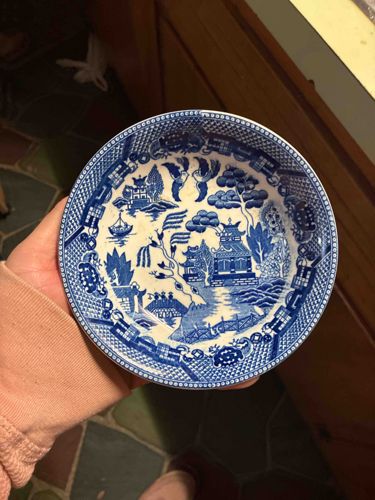
The item is a small, round ceramic bowl or deep saucer, likely made of earthenware or porcelain, featuring the classic blue and white 'Willow Pattern' design. The predominant colors are deep cobalt blue against an off-white or cream background, applied with what appears to be transfer print decoration. The pattern depicts a stylized Chinese landscape scene with common elements such as a three-story pagoda structure, a bridge with three figures, a boat, an apple tree, and two doves or swallows in flight at the top. The border of the bowl is also decorated with a geometric pattern, often referred to as a 'fret' or 'cell' border, interspersed with smaller elements resembling houses or pagodas. The bowl has a smooth, glazed finish, typical of dinnerware. Its size is suitable for a small serving dish, perhaps for a side item, soup, or a dessert. There are no visible chips, cracks, or significant wear marks, suggesting it is in good to excellent condition. The glazing appears intact and uniform. Without handling the item, it is difficult to determine manufacturing marks, but the quality of the transfer print seems clear and well-defined, indicating reasonable craftsmanship. The Willow Pattern was popularized in the late 18th century and has been continuously produced by various manufacturers up to the present day, making precise dating without a maker's mark challenging. However, the slightly muted tones of blue might suggest an earlier production, though this is speculative. The pattern itself is a hallmark of Chinoiserie style, a European interpretation of Chinese aesthetic traditions.
AI Appraisal Report
I've examined the provided image of the Blue and White Willow Pattern Bowl. Visually, the bowl appears to be in good to excellent condition with no obvious chips, cracks, or significant wear. The transfer print is clear and well-defined, and the glazing appears intact and uniform. The classic Willow Pattern design, with its distinctive pagoda, bridge, figures, boat, apple tree, and doves, is clearly depicted.
Authenticity: Based on the image alone, I can confirm it's a Willow Pattern piece. However, precise authentication regarding its age and specific manufacturer without a maker's mark is challenging from images. The slightly muted blue tones could hint at an earlier production, but this is merely speculative. Many manufacturers produced this pattern over centuries.
Market Conditions and Comparables: The Willow Pattern remains popular. Smaller bowls or deep saucers like this typically fetch modest prices unless they have significant age, a rare maker's mark, or exceptional provenance. Comparables from online auction sites and antique dealers for common Willow Pattern bowls in similar condition range widely. Mass-produced items from the 20th century are abundant.
Demand and Rarity: Demand for general Willow Pattern pieces is steady but not high for common items. Rarity is low unless it's an unusually early piece from a renowned pottery or has unique characteristics not visible here.
Factors Impacting Value: Condition is excellent, which positively impacts value. However, the lack of a visible maker’s mark and definitive age reduces its premium. Its size suggests a utilitarian rather than decorative primary purpose, which also affects collectability slightly.
Limitations: A full authentication would require in-person examination to check for maker's marks (often on the base), assess the ceramic body (e.g., earthenware vs. porcelain), and scrutinize the print quality under magnification for signs of hand-painting vs. purely transfer print, which could indicate an earlier or higher-quality piece. Provenance documentation (e.g., original sales receipts) would significantly add to its value if it suggests a notable history. Scientific testing, like thermoluminescence, could definitively date the ceramic but is generally impractical and costly for an item of this likely value.