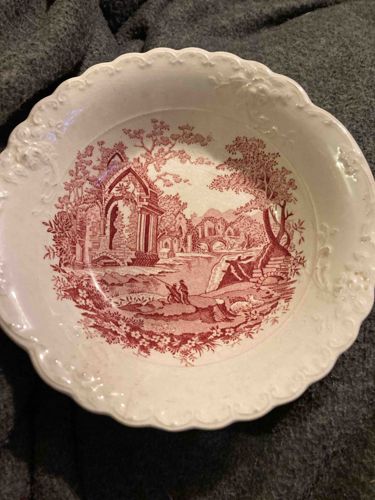
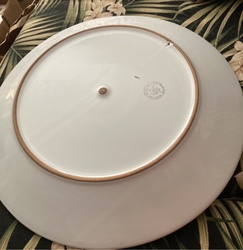
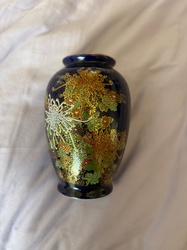
White ceramic bowl with Red design in middle. Bottom marking :English Ahbag??
These notes were written by the person who submitted this item. Appraiser.AI has not verified them, and the AI's identification and estimate may rely on them.
AI Estimated Value
Not an official valuation
$75 - $125
AI estimate as of June 9, 2025 · verify with a professional before acting
AI-Generated · Verify before acting
Everything on this page is generated by AI for informational purposes only. AI can make mistakes — the AI may misidentify items or misattribute them (artist, maker, brand, designer, origin, era). This is not an official valuation and should not be used for insurance, sale, tax, estate, legal, or lending purposes — or any decision requiring a certified appraisal. It is not an authoritative claim about any person, brand, or rights holder — do not share or rely on it as a factual statement about a third party. Always consult qualified professionals before making financial decisions.
This analysis also relies on unverified notes provided by the user, which may be incomplete or inaccurate and could affect the result.
This is a white ceramic bowl with a reddish-pink transfer-printed design in the center. The design depicts a landscape scene within a reserve, featuring a ruin, trees, a body of water, and figures. The rim of the bowl is scalloped and features raised decorative molding, likely floral or scrollwork although the detail is somewhat obscured. The overall form appears to be a shallow bowl or possibly a serving dish. Visible condition issues include crazing across the surface, which is a network of fine cracks in the glaze, and likely some wear consistent with age and use. There may be minor chips or damage to the raised decorations on the rim, but this is not clearly discernible from the image. The underside is not visible, but the provided context mentions a 'Bottom marking: English Ahbag??' This suggests the item is likely English earthenware, possibly dating from the Victorian era or earlier, given the romantic landscape scene and transfer printing technique. The quality of the transfer printing appears relatively consistent, and the raised rim decoration indicates a greater level of craftsmanship than purely plain forms. The 'Ahbag' part of the mark is likely a misreading of a manufacturer's name or pattern name. Identifying the specific maker based solely on this image and partial information is difficult but the style strongly suggests Staffordshire pottery.
AI Appraisal Report
Upon reviewing the image of this white ceramic bowl with a reddish-pink transfer-printed design, I observe a typical example of English Transferware. The central landscape scene, featuring a ruin, trees, water, and figures, is characteristic of popular patterns produced during the 19th century, likely the Victorian era. The scalloped rim with raised molding adds a decorative element, suggesting a mid-range production quality rather than basic utility ware. Condition is a significant factor; the visible crazing across the surface is expected with age but does diminish value. Potential minor damage or wear to the raised rim decorations is also likely, although not clearly discernible from the image. The reported bottom marking 'English Ahbag??' strongly suggests English origin and likely earthenware. Based on the style and common marks, 'Ahbag' is almost certainly a misreading of a manufacturer's name or pattern, but without a clear image or documentation, specific maker identification is impossible from this vantage point. This limits precise dating and market comparison to specific makers. Transferware is a widely collected field, with demand varying based on pattern rarity, maker, condition, and form. This particular form appears to be a shallow bowl, a relatively common shape. Market comparables for similar, unidentified, crazed English earthenware bowls with romantic landscape scenes and decorative rims typically fall into a modest range. To definitively authenticate the maker and age, an in-person examination of the bottom mark, closer inspection for chips or repairs, and possibly provenance documentation is necessary. Without physical inspection, I cannot rule out later reproductions, though the style suggests authenticity within its likely era.