AI estimate as of November 8, 2025 · verify with a professional before acting
AI-Generated · Verify before acting
Everything on this page is generated by AI for informational purposes only. AI can make mistakes — the AI may misidentify items or misattribute them (artist, maker, brand, designer, origin, era). This is not an official valuation and should not be used for insurance, sale, tax, estate, legal, or lending purposes — or any decision requiring a certified appraisal. It is not an authoritative claim about any person, brand, or rights holder — do not share or rely on it as a factual statement about a third party. Always consult qualified professionals before making financial decisions.
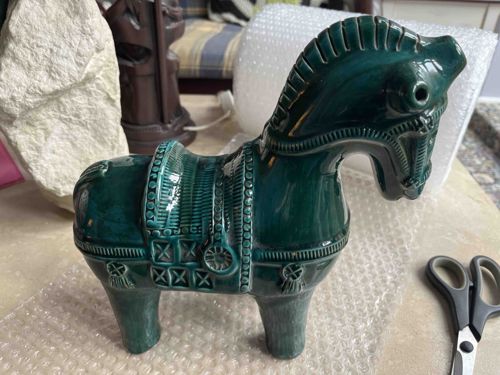
This item is a ceramic figurine depicting a horse, likely inspired by Tang Dynasty styles. The horse is rendered in a stylized, somewhat squat form, standing on four thick, cylindrical legs. Its primary color is a rich, dark emerald green, achieved through a vibrant, high-gloss ceramic glaze that creates reflective surfaces. The mane is sculpted with distinct, relief-like ridges, and the bridle and saddle are highly detailed with embossed patterns. These patterns include raised dots along the edges of the saddle, geometric X-shapes within square frames on the side panels, and circular motifs that resemble rosettes or wheels. The horse's head features prominent, large eyes and a mouth indicated by subtle indentations. There's a small circular opening on its nose. While the overall form is solid, one can infer from the design elements and typical ceramic production that it is hollow. The craftsmanship appears good, with clear details in the molding and an even application of the glaze, contributing to its decorative appeal. There are no obvious signs of significant damage like chips or cracks apparent from the image, but without closer inspection of the base or reverse side, manufacturing marks are not discernible. The glossy finish and vibrant color suggest it is a decorative art piece, possibly intended for a mantelpiece or display shelf. Its robust build and intricate detailing indicate a piece of quality ceramic artistry, reminiscent of ancient East Asian equestrian sculptures but likely a more modern decorative interpretation.
AI Appraisal Report
I have examined the provided image of the ceramic figurine, which depicts a horse in a Tang Dynasty-inspired style with a vibrant emerald green glaze. The item appears to be in good condition based on the visual evidence, with no obvious chips, cracks, or significant glaze imperfections visible. The molded details, including the mane, bridle, and saddle patterns, are clear and well-defined, indicating a decent level of craftsmanship. The glossy finish is even across the surface.
Authenticity, particularly regarding its age and origin, is a primary concern. While the style evokes ancient East Asian equestrian sculptures, the overall execution, especially the uniformity of the glaze and the somewhat stylized, decorative nature, suggests this is a modern decorative piece rather than an antique Tang Dynasty artifact. The specific details, like the embossed X-shapes and circular motifs, are more common in contemporary interpretations.
Market conditions for such decorative ceramic pieces are generally stable, but demand is for aesthetically pleasing items rather than historical artifacts. Similar new or gently used decorative ceramic horse figurines of this size and quality typically retail in the $75 to $250 range, depending on the retailer and specific design. This is not a rare item; many such reproductions and interpretations are available.
To fully assess authenticity and definitively determine age, in-person examination would be crucial. I would need to inspect the base for maker's marks, examine the ceramic body for porosity, assess the weight and feel, and potentially perform scientific testing such as thermoluminescence dating to confirm age. Without physical inspection and provenance documentation, I cannot authenticate this as an antique. My appraisal is based on it being a contemporary decorative ceramic item.