AI estimate as of December 10, 2025 · verify with a professional before acting
AI-Generated · Verify before acting
Everything on this page is generated by AI for informational purposes only. AI can make mistakes — the AI may misidentify items or misattribute them (artist, maker, brand, designer, origin, era). This is not an official valuation and should not be used for insurance, sale, tax, estate, legal, or lending purposes — or any decision requiring a certified appraisal. It is not an authoritative claim about any person, brand, or rights holder — do not share or rely on it as a factual statement about a third party. Always consult qualified professionals before making financial decisions.
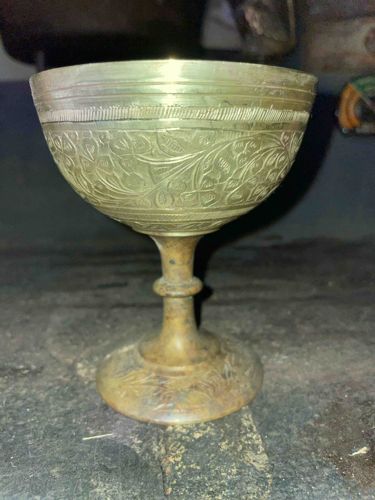
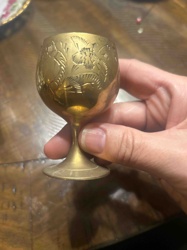
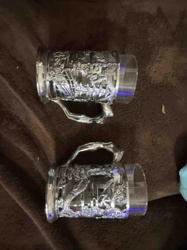
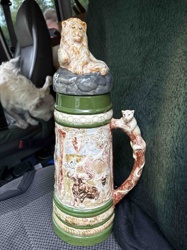
This item is an antique or vintage goblet, likely crafted from brass or a bronze alloy, given its warm, yellowish-brown metallic hue and the visible patina. The goblet features a traditional stemmed design, comprising a bowl, a relatively short stem with a decorative knop (a rounded, annular swelling), and a circular foot. The most striking features are the intricate etchings or engravings that adorn portions of its surface. The bowl is decorated with a detailed foliate or floral pattern, possibly depicting leaves and vines, covering the majority of its exterior. Above this primary design, near the rim, there is a band of geometric patterns, perhaps cross-hatching or parallel lines, which adds a decorative border. The foot also appears to have some faint, shallow etching, possibly repeating elements of the main design or a simpler motif. The overall condition shows signs of significant age and use, with a dark, uneven patina covering much of the surface, particularly noticeable on the stem and foot, indicating oxidation and tarnishing over time. There are no obvious signs of significant damage like dents or cracks from the visible angles, but the surface exhibits a dullness consistent with aged metal rather than a polished finish. The craftsmanship suggests it was either hand-etched or produced using a technique that allowed for such fine detail. The design elements hint at either Middle Eastern, Indian, or possibly European influences from an earlier, ornate period. Without maker's marks, pinpointing an exact date is difficult, but the style and visible wear suggest it could date from the late 19th to early 20th century.
AI Appraisal Report
Based on my visual examination of the provided image, this etched brass or bronze goblet presents as an authentic antique or vintage piece, likely dating from the late 19th to early 20th century. The warm metallic hue, visible patina, and traditional stemmed design are consistent with objects of this type and age. The intricate foliate and geometric etchings are well-executed, suggesting either skilled hand-craftsmanship or a detailed manufacturing process. Its condition, characterized by a dark, uneven patina and general dullness, aligns with expected natural aging and use, without apparent major dents or cracks from the visible angles. This level of wear typically enhances, rather than detracts from, its antique appeal.
Market conditions for decorative metalware of this nature are generally stable but not exceptionally strong, unless attributed to a renowned maker or specific historical significance. Comparable items, often found in antique markets or online, typically range from $50 to $200 depending on the intricacy of design, material quality, and provenance. The lack of maker's marks, which is common for such items, limits its marketability to some extent. Demand is moderate, primarily from collectors of decorative arts or those seeking period-appropriate accent pieces. While not extremely rare, the fine detail of the etching is a positive factor.
Factors significantly impacting value include the material (brass vs. bronze, with bronze generally commanding a slightly higher price), the extent and quality of the etching, and the overall state of preservation. The absence of specific provenance or maker's marks is a limiting factor.
It is important to note the limitations of an appraisal based solely on images. Full authentication and a more precise valuation would necessitate an in-person examination to verify the metal composition, assess the condition of the etching and surface more thoroughly for any repairs or alterations, and possibly search for any faint, unphotographed maker's marks. Scientific testing (e.g., XRF analysis) could definitively confirm the metal alloy. Without these, the authenticity is assessed based on visual congruity with known historical examples and expected aging characteristics.