AI estimate as of October 27, 2025 · verify with a professional before acting
AI-Generated · Verify before acting
Everything on this page is generated by AI for informational purposes only. AI can make mistakes — the AI may misidentify items or misattribute them (artist, maker, brand, designer, origin, era). This is not an official valuation and should not be used for insurance, sale, tax, estate, legal, or lending purposes — or any decision requiring a certified appraisal. It is not an authoritative claim about any person, brand, or rights holder — do not share or rely on it as a factual statement about a third party. Always consult qualified professionals before making financial decisions.
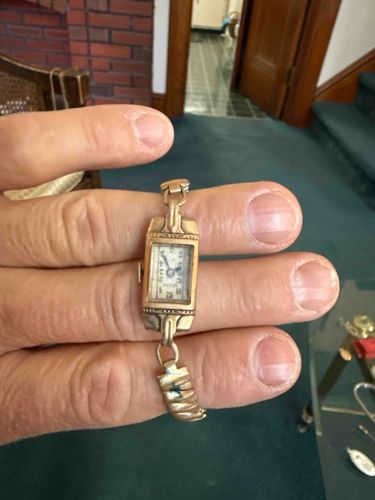
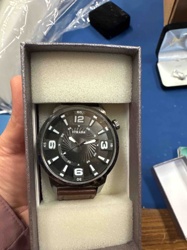
This item is a vintage ladies' wristwatch, characterized by its small, rectangular, gold-tone casing. The watch face is white, displaying black Arabic numeral hour markers except for the 12, 3, 6, and 9 o'clock positions which appear to be stylized or possibly missing as a design choice, though the image resolution makes this difficult to ascertain definitively. The hands are a dark, likely blued steel or black. The brand name 'BULOVA' is visible on the dial, indicating its manufacturer. The watch case itself appears to be made of a yellow gold-plated or gold-filled metal, exhibiting some wear and discoloration, suggesting age and use. There are subtle decorative embossed details on the top and bottom edges of the watch case. It is attached to a flexible, possibly stretchable, gold-tone bracelet, though only a small portion of the attachment mechanism and the beginning of the band are visible. A particularly unique and unusual feature is a charm, seemingly a real animal tooth (possibly a canine or bear claw), that is attached to a loop extending from the bottom of the watch case. The tooth has a natural, off-white to yellowish hue with darker markings or natural imperfections, and appears to be capped or mounted with a metal finding, which is then connected to the watch. Its condition shows signs of wear consistent with an older item, including scuffing and minimal loss of plating or patina on the metal surfaces, and the tooth charm itself has a weathered appearance. The overall aesthetic points to a style popular in the mid-20th century, likely between the 1940s and 1960s. The craftsmanship, while not exquisitely ornate, appears typical for a quality fashion watch of its era, with the added unique element of the charm.
AI Appraisal Report
Based on my visual examination of the provided image, this vintage ladies' Bulova wristwatch with a unique tooth charm presents as an authentic piece from the mid-20th century, likely 1940s-1960s. The Bulova signature on the dial appears consistent with period examples. The gold-tone casing and bracelet show visible wear, including scuffing and some loss of plating or patina, which is expected for an item of this age that has been worn. The white dial and black Arabic numerals (with stylized or missing markers at 12, 3, 6, 9) combined with dark hands contribute to its vintage aesthetic. The most distinctive feature is the animal tooth charm, which appears to be a genuine tooth, mounted in metal and attached to the watch case. Its weathered appearance aligns with the age of the watch.
Market conditions for vintage Bulova ladies' watches of this style, without precious metals, are generally moderate. While Bulova is a respected brand, many vintage ladies' models do not command high prices unless they are solid gold, diamond-set, or have exceptional complications. Comparables for similar gold-filled or plated Bulova watches range from $50 to $150 depending on condition and specific model. The addition of the tooth charm is a unique element that could attract a niche collector. It adds character and a talking point, potentially enhancing demand slightly, but it doesn't contribute significant monetary value unless the tooth itself proves to be from a rare or culturally significant animal. The condition, with evident wear on the plating and unknown functionality of the movement, impacts value negatively.
Limitations in authenticity verification are significant without a physical examination. I cannot verify the movement's functionality, its originality to the case, or whether the 'missing' numerals are a design choice or damage. Most importantly, I cannot definitively confirm the species of the animal tooth, nor its authenticity as a natural item versus a replica, or rule out any ethical considerations regarding its origin. Full authentication would require in-person inspection to assess the movement, materials, and a professional examination of the charm, possibly including scientific analysis of the tooth. Provenance documentation for the charm would also be beneficial if available.