AI estimate as of September 19, 2025 · verify with a professional before acting
AI-Generated · Verify before acting
Everything on this page is generated by AI for informational purposes only. AI can make mistakes — the AI may misidentify items or misattribute them (artist, maker, brand, designer, origin, era). This is not an official valuation and should not be used for insurance, sale, tax, estate, legal, or lending purposes — or any decision requiring a certified appraisal. It is not an authoritative claim about any person, brand, or rights holder — do not share or rely on it as a factual statement about a third party. Always consult qualified professionals before making financial decisions.
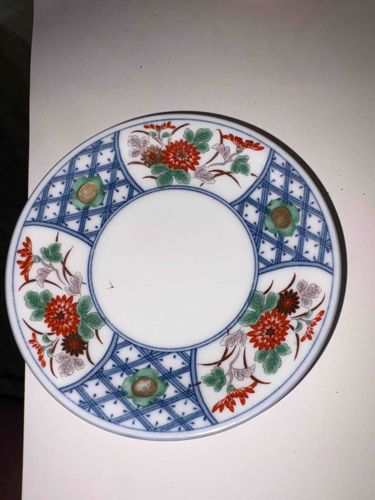
This item is a circular, shallow porcelain saucer or small plate, approximately 4-6 inches in diameter, featuring a vibrant Imari-style decoration. The primary colors in the intricate design are a rich cobalt blue, a fiery persimmon/orange-red, olive green, and touches of light purple/mauve, all set against a clean white porcelain ground. The central part of the saucer is a plain white circle, possibly intended for a teacup or as a blank canvas for food. Surrounding this central well, the design is divided into four distinct quadrants. Two opposing quadrants feature a deep blue 'basketweave' or 'net' pattern with white dots, overlaid with small, circular medallions that appear to be gilded or in an iridescent brown color, outlined in green. The other two opposing quadrants showcase a floral motif dominated by large, detailed chrysanthemum blossoms in red/orange, accompanied by green leaves and delicate stems with smaller lavender-colored flowers or buds. A thin, dark blue line defines the rim of the saucer, adding a neat finish. The craftsmanship appears to be of good quality, with fine lines and careful color application, typical of traditional Japanese porcelain. No visible chips, cracks, or significant wear are immediately apparent from the image, suggesting good preservation or gentle use. The overall style points to a Japanese origin, likely mid-20th century or earlier, given the classic Imari color palette and floral patterns. The precise nature of the porcelain body and any manufacturer's marks are not discernible from the provided image.
AI Appraisal Report
Upon visual examination of the provided image, I have assessed this Japanese porcelain saucer, which features a classic Imari-style decorative scheme. The piece measures approximately 4-6 inches in diameter and presents a vibrant palette of cobalt blue, persimmon red-orange, and olive green, with subtle lavender accents. The design is well-executed, with alternating panels of a 'basketweave' pattern and traditional floral motifs, centered around a plain white well. Based on the style and color application, I believe this is a 20th-century piece, likely from the mid-century period, produced for the export market.
The item appears to be in excellent condition, with no visible chips, cracks, or significant wear to the glaze or gilding. Such good preservation is a positive value factor. The market for individual saucers or small plates of this type is generally modest. While complete sets or older, finer examples from the Edo or Meiji periods can command high prices, single, later-period saucers are more common and accessible. Demand exists among collectors of Japanese porcelain and those who appreciate the decorative Imari style. Current market comparables for similar mid-20th-century Imari saucers place their value in a relatively low range.
The primary limiting factor in this appraisal is the reliance on a single image. A full, definitive authentication would require in-person examination to assess the weight, texture of the porcelain body, and to search for any maker's marks, reign marks, or stamps on the underside. Without physical inspection, I cannot confirm the exact age, specific kiln, or definitively rule out a high-quality reproduction. However, based on the visual evidence, it presents as a genuine, decorative piece of 20th-century Japanese porcelain.