AI Appraisal Estimate

AI-generated estimates · not official valuations

From the user

What was submitted

Photo and notes provided by the user — not generated by AI

Submitted item photo
Submitted photo · June 18, 2026

User's notes

Zinn

AI analysis below

AI appraisal

AI analysis & estimate

AI-Generated · Verify before acting

Everything below is generated by AI for informational purposes only. AI can make mistakes — the AI may misidentify items or misattribute them (artist, maker, brand, designer, origin, era). This is not an official valuation and should not be used for insurance, sale, tax, estate, legal, or lending purposes — or any decision requiring a certified appraisal. It is not an authoritative claim about any person, brand, or rights holder — do not share or rely on it as a factual statement about a third party. Always consult qualified professionals before making financial decisions.

Note

This analysis also relies on unverified notes provided by the user, which may be incomplete or inaccurate and could affect the result.

Read the full disclaimer

AI Identification

·Not independently authenticated·Verify before acting

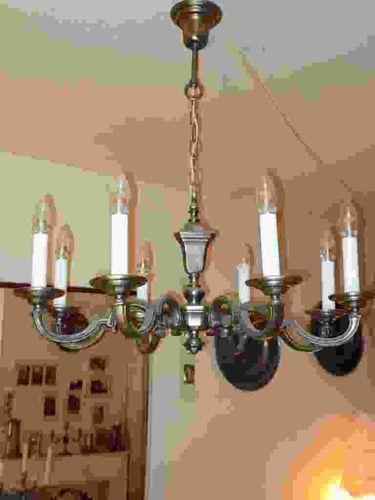
Flemish-Style 8-Light Pewter (Zinn) Chandelier

Antique & Vintage Lighting

AI Estimated Value

·Not an official valuation·Verify before acting

$450 - $650

As of June 18, 2026

AI Item Analysis

·AI can make mistakes·Verify before acting
This is an eight-light chandelier crafted in the traditional Flemish or Dutch Baroque style. The piece is constructed primarily from zinn (pewter), exhibiting a characteristic dull gray, matte metallic finish that distinguishes it from more common brass lighting. The central baluster is composed of multiple cast segments, including a distinctive urn-shaped upper section and a rounded base finial. Eight scrolled, S-curved arms emanate from the central hub, each supporting a wide drip pan and a white candle-sleeve socket. These sleeves are equipped with modern electric candle bulbs. The chandelier is suspended from a link chain and a matching bell-shaped pewter ceiling canopy. The craftsmanship is indicative of mid-20th-century European production, likely from Germany or the Benelux region, where zinn was a popular material for traditional lighting recreations. The metal shows a natural aged patina with slight surface oxidation and dust accumulation in the crevices, but it remains structurally sound with no visible breaks in the metalwork. The scale is medium-sized, suitable for a dining or entrance hall, demonstrating high-quality casting and classic aesthetic balance.
AI Appraisal Report

·AI can make mistakes·Verify before acting
I have carefully examined the provided details and images of the Flemish-Style 8-Light Pewter (Zinn) Chandelier. The piece is a mid-20th-century interpretation of the Dutch Baroque style, likely manufactured in Germany or the Netherlands where 'Zinn' (pewter) casting for domestic lighting was highly localized and respected. The casting quality appears high, with well-defined baluster segments and elegant S-scroll arms characteristic of the 17th-century aesthetic. Condition-wise, the chandelier displays a desirable aged patina with minor oxidation, which adds vintage character without compromising structural integrity. While the electrical components are modern, the use of pewter over the more common brass makes this a more niche piece, appealing specifically to collectors of 'Country French' or 'Old World' interiors. Currently, the market for large-scale traditional lighting is stable, though influenced heavily by the shift toward minimalist decor. Comparables for 8-light pewter fixtures of this era typically realize between $400 and $700 at regional auctions or specialized vintage lighting outlets. Limitations: This appraisal is based on visual data only. A physical inspection is required to determine the lead content of the pewter alloy and to search for manufacturer hallmarks or 'angel' marks often found on high-quality German pewter. Without a physical continuity test of the wiring or a search for provenance documentation (such as an original bill of sale from a maker like Frieling or similar zinn-meisters), I cannot verify the exact foundry of origin. For definitive authentication, I would need to observe the assembly method—specifically whether the arms are pinned or screwed—to better distinguish this 20th-century reproduction from an earlier 19th-century example.

Get your items appraised

Instant estimates of your treasures with AI-powered appraisals

Browse More Appraisals