AI estimate as of November 10, 2025 · verify with a professional before acting
AI-Generated · Verify before acting
Everything on this page is generated by AI for informational purposes only. AI can make mistakes — the AI may misidentify items or misattribute them (artist, maker, brand, designer, origin, era). This is not an official valuation and should not be used for insurance, sale, tax, estate, legal, or lending purposes — or any decision requiring a certified appraisal. It is not an authoritative claim about any person, brand, or rights holder — do not share or rely on it as a factual statement about a third party. Always consult qualified professionals before making financial decisions.
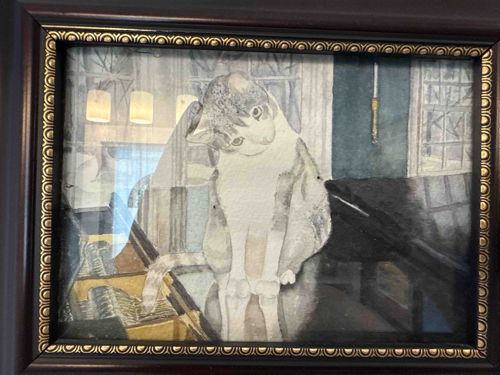
This item is a framed watercolor painting depicting a cat sitting gracefully near a grand piano within an interior setting. The cat, rendered in shades of white, gray, and brown, is the central focus, appearing to look directly at the viewer with an attentive gaze. Its fur exhibits subtle variations in color, suggesting a tabby or calico pattern. The background features distinct elements: a grand piano with its lid open to the right of the cat, and what appears to be a window with a grid pattern on the right side of the painting. To the left of the cat, there are hints of bookshelves or a similar piece of furniture, and further left, hanging lights are visible, casting a warm glow. The overall color palette is somewhat muted, dominated by blues, grays, and browns, with touches of yellow and beige. The watercolor medium gives the painting a soft, somewhat diffused quality. The painting is enclosed within a dark brown wooden frame, which features an ornate, gold-colored inner border with a repeating semicircular or scalloped pattern. The frame's dark color provides a strong contrast to the lighter tones of the painting, drawing attention to the artwork. The glass covering the painting shows some reflections, indicating it is likely under glass to protect the watercolor. There are no visible condition issues such as tears, significant fading, or water damage to the artwork itself, though the reflections on the glass make it difficult to ascertain every detail of the painting's surface. No artist's signature or specific manufacturing marks are discernible from the provided images. The style suggests a representational artistic approach, possibly leaning towards a more illustrative or narrative quality given the detailed depiction of the cat and its environment. The craftsmanship of both the painting and the frame appears to be of good quality, suitable for decorative display.
AI Appraisal Report
I have examined the framed watercolor painting depicting a cat by a piano. The artwork itself appears to be in good condition, showing no obvious signs of tears, fading, or water damage, though reflections on the glass make a definitive assessment challenging. The frame is a dark brown wood with an ornate gold inner border, enhancing the presentation.
Authenticity is difficult to ascertain from images alone. There is no visible artist's signature or distinguishing marks, which limits attribution. The style is representational with a somewhat illustrative quality, common in decorative art. Without a signature or provenance, attributing it to a recognized artist is not possible.
In terms of market conditions, unsigned decorative watercolors generally command modest prices. While the subject matter—a cat and a piano—is appealing to a niche audience, the lack of an identifiable artist or significant artistic merit beyond decorative appeal limits its value. Comparable decorative, unsigned watercolor paintings typically sell in the $100-$200 range, depending on size and visual appeal.
Demand for such unsigned decorative pieces is steady but not high-end. Rarity is not a factor here, as similar works are commonly found in secondary markets. The main factors impacting value are the decorative appeal and good condition, offset by the lack of artist identification and limited artistic sophistication.
To fully verify authenticity and potential artistic attribution, I would require an in-person examination to search for hidden signatures, examine paper quality and pigment, and potentially conduct scientific testing to determine age. Provenance documentation, such as purchase receipts or exhibition history, would also be crucial.